
Building Wales’s employability future together
How a community of practice is driving collaboration, innovation and impact for tertiary learners
When colleagues from providers across Wales first came together through the Wales Employability Community of Practice (CoP), they shared a common ambition: to enhance the employability of their learners and better prepare them for an increasingly complex and fast-changing world of work.
Those working to support learner employability often face similar questions:
- How can employability be embedded more effectively within the curriculum?
- How can learners articulate their skills more confidently to employers?
- How can providers and employers strengthen partnerships to enhance learner outcomes and better meet workforce needs?
- How can providers support equitable access to career opportunities?
- How should employability evolve to reflect sustainability and social responsibility?
Established by the Higher Education Funding Council for Wales (HEFCW) to support collaboration and innovation in graduate employability, the Community has evolved alongside Wales’s changing tertiary education landscape. With the creation of Medr and our vision for a more connected and collaborative tertiary system, its membership has broadened to include employability practitioners, academics, careers professionals and professional services colleagues from universities and colleges across Wales, creating a shared platform for learning, innovation and action.
This expanded membership supports the ambitions set out in our Strategic Plan 2025 – 2030 for a “more flexible and joined-up system that equips learners with the skills, knowledge and experiences needed to thrive in a changing economy and society”. United by a common goal of improving learner outcomes, members work across institutional and sector boundaries to strengthen employability, enterprise and entrepreneurship provision and enhance opportunities for learners throughout their learning journey.
Funded by Medr and coordinated by Advance HE, the Community has become a unique, sector-led pan-Wales platform for employability collaboration. By fostering the exchange of evidence-informed practice, it enables members to collectively address common challenges and develop solutions that anticipate and respond to emerging sector needs.
From conversations to collective action
At a time when technological advances, sustainability priorities, skills shortages and evolving employer expectations are reshaping the world of work, the Community demonstrates the value of collaboration in action. By sharing expertise, building connections and developing a more coherent national approach to employability, members are strengthening practice across Wales. In doing so, they are creating more meaningful and impactful opportunities for learners to develop the skills, experiences and confidence needed to succeed in a rapidly evolving labour market.
Through symposia, workshops, task-and-finish groups and peer-learning activities, members have been able to openly discuss both successes and challenges to develop evidence-informed solutions. Whether discussing curriculum design, employer engagement, sustainability or skills development, members have the opportunity to learn from one another’s experiences and adapt successful approaches within their own institutions.
“By bringing together academic and professional colleagues from across the Welsh sector, the Community has helped to build stronger working relationships, deepen shared understanding, and develop collective expertise. These connections are already supporting more joined-up approaches to employability and will continue to benefit the sector beyond the immediate scope of this year’s work.”
Co-chairs (2025/26) Professor Fay Short, Associate Pro-Vice Chancellor for Employability at Bangor University, and Bev Herring, Head of Careers and Employability at Aberystwyth University
The Community demonstrates the power of a simple idea: working together delivers better outcomes than working alone.
The following examples demonstrate how collaboration is being translated into practical action and tangible benefits for learners across Wales.
Success Story 1: Speaking the same employability language
What if one of the biggest barriers to employability isn’t a lack of skills, but a lack of shared understanding?
A Community of Practice research project, Are we speaking the same language?, explored the disconnect between how employers, education providers and learners talk about skills, experience and workplace readiness. The findings revealed that learners can often struggle to recognise and articulate the capabilities they have developed, while employers and educators may use different language to describe the same attributes.
By bringing together perspectives from across the tertiary sector, the project is helping to bridge that gap. The resulting insights and resources support providers to create more opportunities that that give learners exposure to real-world industry expectations and workplace skills, while helping them articulate their experiences into language that resonates with employers.
More than a research project, it is a practical example of how the Community of Practice is helping Wales build a more connected employability ecosystem, one where learners, providers and employers have a shared understanding of the skills needed to succeed.
“The significant gap between explicit and implicit language in job descriptions means talented graduates may be missing opportunities simply because they can’t decode what employers are really asking for. This affects not just individual careers, but the effectiveness of graduate recruitment across all sectors.”
Stuart Norton, Head of Educational Excellence, Advance HE
Success Story 2: Putting sustainability at the heart of learner futures
As employers increasingly seek graduates who can help address social, environmental and economic challenges, the Wales Community of Practice has been exploring how employability can evolve to meet these expectations.
Providers from across Wales came together to investigate how the sustainability principles underpinning the Well-being of Future Generations Act 2015, including long-term thinking, prevention, collaboration, involvement and integrated decision-making, could be embedded into career development activities and learning experiences. This collaborative work led to the pan-Wales project, Embedding ethical and sustainable employability in tertiary education: best practice, which gathered and analysed 49 examples of practice from across the sector. The work also produced a toolkit designed to help higher education institutions embed ethical and sustainable employability into their teaching, careers provision and institutional practice.
The examples showcased a remarkable breadth of activity, including:
- Curriculum initiatives linked to sustainability challenges.
- Partnerships with employers focused on social impact.
- Student projects connected to the UN Sustainable Development Goals.
- Activities aligned with the Well-being of Future Generations (Wales) Act.
- Volunteering, enterprise and leadership programmes that encourage responsible citizenship.
Collectively, these examples demonstrate how employability can extend beyond preparing learners for work to also preparing them to make a positive contribution to society and the organisations they join. The project highlighted practical ways of developing the knowledge, skills, values and behaviours needed for an increasingly complex and rapidly changing world.
Importantly, the findings provide a valuable evidence base for the sector, showcasing how sustainability, social responsibility and employability can be meaningfully integrated through curriculum design, employer engagement, enterprise activity and community-based learning. They are now informing the development of practical resources and tools that will help providers strengthen their own approaches and embed ethical and sustainable employability more consistently across tertiary education in Wales.
“The passion, dedication and innovation shown by practitioners in the area of ethical and sustainable employability is and will continue to exert a positive impact on students, staff and wider stakeholders.”
Ethical and sustainable employability project team
Success Story 3: Preparing learners for an AI-enabled future
The College Merthyr Tydfil is piloting an innovative employability project that equips learners with in demand AI, cloud and data skills through a suite of short, industry-recognised digital qualifications that allow learners to develop and evidence specific workplace and technical skills.
Delivered in partnership with the National Institute of Learning & Certification (NILC), Fintech Wales and the Royal College of Nursing (RCN), the initiative connects learners aspiring to careers in technology and healthcare with the emerging skills and workforce needs driven by AI and digital innovation.
Through the programme, learners develop skills that have been shaped by employer input and aligned with evolving workforce needs. On completion they receive digital badges that can be showcased on CVs and professional networking platforms such as LinkedIn, helping them evidence their skills to prospective employers and education providers. By creating new pathways into apprenticeships, higher education and rapidly expanding sectors, the initiative offers a scalable and sustainable model that could be rolled out to benefit learners across Wales.
“FinTech Wales is incredibly proud to be working with The College Merthyr Tydfil as the Business Fintech Academy continues to go from strength to strength. Over the past few months, we have already seen the positive impact this academy is having on learners by connecting them directly with employers, real‑world projects and live industry insight.”
Rhys Griffiths, Head of Skills and Talent, FinTech Wales
Building leadership across the sector
While the Community’s projects have delivered valuable outputs, members often point to another significant impact: professional growth.
The CoP has provided opportunities for members to:
- Lead national projects.
- Influence sector policy discussions.
- Share innovative practice with peers.
- Develop research and evaluation expertise.
- Build strategic partnerships across providers.
For emerging leaders, the network has become a pathway into wider sector engagement. For experienced professionals, it has offered a space to mentor colleagues and shape the future direction of employability in Wales. The result is a stronger, more connected community of professionals equipped to lead employability innovation at both institutional and sector levels.
Looking ahead
As Wales continues to develop a more coherent tertiary education system, the need for collaboration, evidence-informed practice and shared learning will only grow.
The Wales Employability Community of Practice has shown what is possible when providers unite around a common purpose. It is a catalyst for sector-wide change helping to shape the future of employability in Wales, and ensure that learners, providers, employers and communities all benefit from a stronger and more connected employability ecosystem.
Together, these initiatives provide a strong foundation for a more joined-up approach to experiential learning and employability development across Wales’s tertiary education system, helping learners acquire the skills, experience and confidence needed to succeed in a changing economy and society.
“It has brought together people passionate about making a difference, enabled friendships to be formed and contributed to ongoing projects that will impact on employability practice throughout Wales and beyond – a true testament to the power of collaborative working.”
Dr Samantha Burvill from Swansea University and co-lead for the project group on ethical and sustainable employability
And perhaps that is the Community’s most important legacy: demonstrating that collaboration is not simply a way of sharing practice, it is a catalyst for change.
Angela West, Senior Skills and Employability Manager
Find out more about Medr’s work
You can subscribe to updates to be the first to know about our publications, news and job opportunities.
SubscribeConcordat to Support Research Integrity updated template and guidance
The Concordat to Support Research Integrity is a UK framework for good research conduct and governance built on a set of four clear commitments for researchers, employers and funders of research, and is designed to maintain high standards and ethical practices that ensure confidence in UK research.
Research organisations funded by Medr are expected to produce annual statements as part of their commitment to the Concordat.
Following the 2025 refresh of the Concordat to Support Research Integrity, the Research Integrity Concordat Signatories (RICS) Group, the steering and governing body responsible for the Concordat, has published a refreshed template and guidance document for these annual statements.
The template launches following extensive UK higher education sector consultation and feedback, with a renewed focus on sharing best practice and illustrating progress.
The revised template will support consistency in reporting and meaningful sector analysis, helping to inform decision making and drive shared improvements in research integrity practice.
Find out more about Medr’s work
You can subscribe to updates to be the first to know about our publications, news and job opportunities.
SubscribeProposal to establish Tenby 3 to 19 Community School
Proposal to establish Tenby 3 to 19 Community School
Medr’s response to Pembrokeshire County Council’s proposal for discontinuing Tenby Voluntary Controlled School and Ysgol Greenhill to establish a new 3-19 Community School.
Response issued by Medr: 03 November 2026
Medr response to Pembrokeshire County Council's proposal 03 November 2026Find out more about Medr’s work
You can subscribe to updates to be the first to know about our publications, news and job opportunities.
SubscribeSta/Medr/15/2026: Consistent performance measures for post-16 learning: Learner destinations, August 2023 to July 2024
Main points
Overview
The overall sustained destination rate has fluctuated between 85% and 86% since 2016/17.
Figure 1: Destinations of post-16 learners, 2014/15 to 2023/24
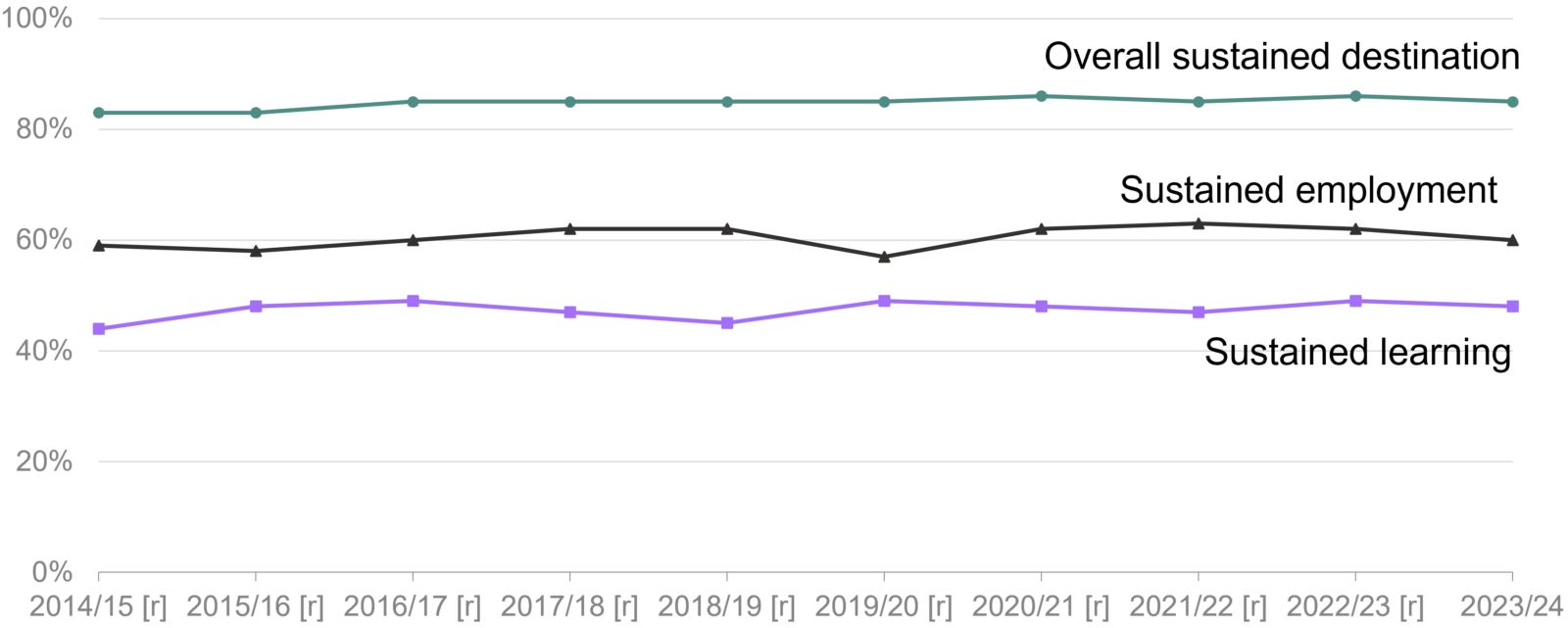
Description: The sustained destination rate has remained relatively stable since 2016/17. It decreased by 1 percentage point between 2022/23 and 2023/24.
[Note r] Previously published figures have been revised with the latest data, see the key quality information for detail.
Data in Table 1a of the accompanying spreadsheet
48% of learners in 2023/24 went onto a sustained learning destination, a decrease from 49% in 2022/23. Sustained employment is the most common destination and the rate decreased for the second year in a row, dropping to 60% in 2023/24 from 62% in 2022/23.
Sta/Medr/15/2026: Consistent performance measures for post-16 learning: Learner destinations, August 2023 to July 2024
Medr statistics
Date: 17 November 2026
Designation: Official statistics in development
Summary: Employment and learning destinations for further education, school sixth form and work-based learning learners in the year following their programme of study.
Theme: Further education, sixth forms, work-based learning
Sta/Medr/15/2026 Consistent performance measures for post-16 learning: learner destinations August 2023 to July 2024Secondary documents
Find out more about Medr’s work
You can subscribe to updates to be the first to know about our publications, news and job opportunities.
SubscribeRefreshing the Digital 2030 framework
Digital 2030 has acted as a catalyst for change since 2019, aiming to create more positive digital experiences for learners and support staff to integrate digital tools and technologies into their teaching.
The original framework was published by the Welsh Government in June 2019. It applies to further education institutions (colleges), core apprenticeship providers, and adult community learning providers.
Medr took on responsibility for Digital 2030 in August 2024.
Why is digital learning important?
Digital skills and capabilities are increasingly needed in everyday life, to find information and access key services. In Digital 2030 we focus on how digital tools and technologies can be used effectively to enhance learners’ experiences.
Learners will need to use digital tools and technology in their future workplaces, so should be given appropriate opportunities to develop digital skills and confidence. In Digital 2030, we consider the links between digital skills and the economy, in line with the Welsh Government’s work to develop a Skills Strategy for Wales.
Digital 2030 emphasises the importance of learners developing digital and technical competencies alongside human skills such as information literacy, problem solving and creative thinking. Digital developments should be strategy-led and pedagogy-driven, and responsive to the needs of learners and staff. We recognise that successful digital change is about people and culture as much as technology.
Why have we updated this framework?
The original version of Digital 2030 in 2019 included a commitment to a mid-term refresh of the framework. In this refresh we aimed to reflect how the sector has evolved and acknowledge significant changes to the context and landscape for digital learning, including:
- The rapid shift to ‘emergency remote education’ required during the Covid-19 pandemic and subsequent recovery period (2020-2021). This highlighted the importance of a strategic approach to digital learning and developing the strong and coherent foundations to underpin digital delivery.
- The availability of generative Artificial Intelligence (AI) tools since late 2022, its rapid adoption by industry and implications for teaching, learning and assessment. Medr has committed to publishing a separate position statement on AI in teaching and learning by March 2027.
- We became operational in August 2024. We’ve taken this opportunity to strengthen alignment between Digital 2030 and our broader strategic approach; particularly in line with our Learner Engagement Code and work on promoting collaboration with trade unions.
Jisc is a key delivery partner for Digital 2030 and we asked them to engage with learning providers, representative bodies and key stakeholders in preparation for updating the framework. Feedback from providers confirmed that the original Vision, Aims and Objectives of Digital 2030 (which form the core backbone of this framework) were sufficiently future-proofed in 2019 and are still valid and valued at this mid-term point.
What did Jisc discover?
The review found substantial progress in digital learning across Wales, alongside a continuing challenge to ensure that progress translates into a positive experience for all learners.
As part of the review, Jisc held focus groups and individual conversations with people across further education, apprenticeships and adult community learning. Participants included senior leaders, curriculum and quality managers, learning technology specialists, IT and data colleagues, and those managing adult and work-based provision.
“I’m grateful to everyone who made time to contribute so openly. People reflected on how digital learning had developed in their organisations, what they had achieved and the challenges they were still working through. Their examples showed providers improving access, adapting delivery and supporting staff, often within considerable constraints.”
Project lead Glyn Rogers (Jisc)
Alongside this engagement, the review drew on provider submissions, Estyn findings and Jisc’s Digital Experience Insights reports for Wales. Overall, the evidence showed stronger digital foundations and generally positive experiences of digital learning. It also showed that good individual practice did not always add up to a joined-up experience for learners. This is illustrated in one of the user stories accompanying the review.
That perspective matters because learners bring different circumstances, confidence and support needs. Some still depend on providers for equipment, connectivity and places to study. Others need help applying familiar technology to learning or work. The survey findings also highlighted the need to strengthen support for digital learning in Welsh and English.
Making all of this happen takes time and coordination. Middle leaders have an important role in connecting organisational ambitions with what teams do in practice. Staff need space to develop approaches together and learn from colleagues. People spoke with clear commitment to improving digital learning, while acknowledging how workload and resource pressures affected what they could sustain.
Providers valued Digital 2030 as a shared reference point and welcomed its flexibility for different settings. They want practical help to carry those ambitions through into everyday experience. The next phase should build on the progress, expertise and commitment already evident across the sector, with a continued focus on a consistently positive and inclusive digital learning experience for learners across Wales.
What happens next?
We are working with Jisc to develop a programme of activities which will support the refreshed framework, focusing on a set of topics which have been informed by sector feedback and other evidence-gathering work.
Our longer term ambition is to set our approach to digital learning more firmly in the tertiary education landscape. The Digital 2030 framework document notes some initial steps which we are taking towards this goal, and identifies some known factors in the coming years which will influence our future approach.
There is more information about Medr’s work on our Digital learning page.
QueriesFind out more about Medr’s work
You can subscribe to updates to be the first to know about our publications, news and job opportunities.
SubscribeUpdated Digital 2030 framework responds to new opportunities and challenges in digital learning
- Medr publishes refreshed Digital 2030 framework for digital learning after latest review shows digital is now mainstream.
- The digital learning landscape has changed since 2019, with Covid-accelerated adoption of digital delivery in teaching and learning and the introduction of generative AI.
- Both digital and human skills remain highly valued and essential to the Welsh economy.
Digital tools and technology have become much more widely embedded in post-16 education over the past seven years and there is a growing culture of collaboration and innovation by learning providers. For colleges in particular, there have been significant levels of investment to improve core infrastructure which underpins digital delivery and services.
This was one of the conclusions from a mid-term review of the Digital 2030 framework, according to Jisc, which delivers digital support to higher and further education providers across the UK.
Originally launched in 2019, Digital 2030 is the strategic framework which sets out a shared vision and aims for using digital technology as an integral part of teaching and learning, to enhance the learner experience in further education, apprenticeships and adult community learning.
Digital 2030 reflects the need for learners to develop digital skills and experiences of using digital tools and technology alongside the human skills, face-to-face contact and interactions with other learners, tutors and staff, which remain a core part of the learning experience.
Jisc’s mid-term review involved conversations with learning providers and key stakeholders to consider progress against the original Digital 2030 ambition and if its priorities needed to be updated.
The review found that substantial progress had been made towards creating a strong foundation for digital delivery, with improving the coherence and consistency of digital practice and learner experiences being a key challenge for the next phase of the framework. The review also confirmed the continued relevance and value of retaining the original vision, aims and objectives.
The updated Digital 2030 framework reflects:
- The need to make the learner experience more coherent and consistent, now that digital infrastructure, tools and ways of working are more embedded.
- The need to promote examples of good learner practices and practical guidance for sector staff.
- Areas that have been prioritised for further consideration or improvement during the next phase of the framework, including better Welsh and bilingual digital provision and digital inclusion.
James Owen, Chief Executive of Medr, said:
“Digital learning matters. The flexibility that it offers can help to reduce barriers to participation in learning activities, and increase learners’ ownership of their learning.
“The digital landscape has evolved significantly since Digital 2030 was originally developed, creating an opportunity to reflect on emerging technologies, changing user expectations and new strategic priorities. We want learners to develop the digital capabilities and confidence that will help them during their learning journey and in everyday life preparing them for their future careers.
“We are already seeing the practical results of learners having access to more digital opportunities. One learner reported that they had developed their skills by getting involved in their college’s wider digital activities, before they went on to take up a digital role in industry after qualification.”
Rhys Daniels, Director for Wales, Scotland and Northern Ireland at Jisc said:
“Jisc’s Digital 2030 mid-term review highlights the significant progress made by colleges, apprenticeship providers and adult community learning groups across Wales. Their leadership, innovation and commitment to collaboration have helped make digital an integral part of teaching and learning, and that achievement deserves recognition.
“As Digital 2030 moves into its next phase, our review points to the importance of building on those foundations and translating good digital practice into more consistent, inclusive and joined-up experiences for learners. This means giving staff and those leading teaching and learning practical support, sharing what effective digital learning looks like, strengthening Welsh language provision and accessibility, and helping providers respond confidently and responsibly to developments such as artificial intelligence.
Digital 2030: A strategic framework for post-16 digital learning in Wales – updated 2026 Medr's digital learning website page“Medr’s leadership in refreshing Digital 2030 provides an important opportunity to turn the findings of Jisc’s review into meaningful improvements for learners. We are proud to be working alongside Medr and providers across the sector to help develop practical guidance and support that strengthens digital learning across Wales.”
Notes
Digital 2030 is the strategic framework for digital learning in further education, apprenticeships and adult community learning. It was originally launched in 2019 by the Welsh Government and was co-created with input from the sector. Jisc is a key delivery partner for Digital 2030.
Medr took over responsibilities for Digital 2030 and digital learning in tertiary education environments in August 2024.
AI is now influencing day-to-day teaching, learning and assessment. Medr has published findings from a separate piece of exploratory work by Jisc alongside the refreshed Digital 2030 framework. Medr is also developing a position on AI in teaching and learning by March 2027.
Medr has asked colleges to develop three-year digital capital expenditure plans and has focused support on longer-term, more strategic investment, while retaining flexibility for innovation and emerging need.
Find out more about Medr’s work
You can subscribe to updates to be the first to know about our publications, news and job opportunities.
SubscribeMedr/2026/51: Adult Community Learning Teaching and Learning Conference Attendance Fund
Introduction
1. This publication sets out a one-off allocation of £13,200 to support investment in professional development for part-time and/or hourly paid Adult Community Learning (ACL) staff through attendance at the ACL Teaching and Learning Conference 2026/27.
2. This will support Medr’s duty under section 5 of the Tertiary Education and Research (Wales) Act 2022 to promote continuous improvement in the quality of tertiary education, including through supporting the capability and continuing professional development of the tertiary education workforce.
3. For the purposes of this funding, Adult Community Learning refers to provision delivered by providers who are allocated Community Learning Grant (CLG). This provision offers part-time learning opportunities from Entry Level to Level 2 for learners aged 19 and over and is typically delivered in community settings.
4. As per paragraph 57 of Medr/2026/16: Medr’s investment for academic year 2026/27, CLG investment for Bridgend County Council will be allocated to Bridgend College, as was the case in AY 2025/26.
Allocation
5. A total of £13,200 is allocated equally across providers delivering Adult Community Learning as set out in Table 1.
6. While Adult Community Learning funding is allocated on a formula basis, this fund is distributed on an equal basis across providers. This reflects its purpose as a one-off intervention where a minimum level of resource is needed to enable meaningful staff training activity. An equal allocation approach ensures consistent opportunity for participation and avoids very small allocations that would limit impact, particularly for smaller or more rural providers.
| Local Authority | Total allocation |
|---|---|
| Blaenau Gwent County Borough Council | £600 |
| Bridgend College | £600 |
| Caerphilly County Borough Council | £600 |
| Cardiff Council | £600 |
| Carmarthenshire County Council | £600 |
| Ceredigion County Council | £600 |
| Conwy County Borough Council | £600 |
| Denbighshire County Council | £600 |
| Flintshire County Council | £600 |
| Gwynedd Council | £600 |
| Isle of Anglesey County Council | £600 |
| Merthyr Tydfil County Borough Council | £600 |
| Monmouthshire County Council | £600 |
| Neath Port Talbot County Council | £600 |
| Newport City Council | £600 |
| Pembrokeshire County Council | £600 |
| Powys County Council | £600 |
| Rhondda Cynon Taf County Borough Council | £600 |
| Swansea Council | £600 |
| Vale of Glamorgan Council | £600 |
| Torfaen County Borough Council | £600 |
| Wrexham County Borough Council | £600 |
Use of funding
7. Funding must be used within the 2026/27 academic year, for part time and/or hourly paid tutor attendance at the ACL Teaching and Learning Conference (date tbc).
8. Local Authorities must email [email protected] by 31 July 2027 where funding cannot be allocated for the purposes outlined above.
9. Reclaims will be processed by October 2027.
Medr/2026/51: Adult Community Learning Teaching and Learning Conference Attendance Fund
Date: 23 October 2026
Reference: Medr/2026/51
To: Directors of Education of Local Authorities; Principal of Bridgend College
Respond by: 31 July 2027
Summary: One-off allocation of £13,200 to support investment in professional development for part-time and/or hourly paid Adult Community Learning (ACL) staff through attendance at the ACL Teaching and Learning Conference 2026/27.
Medr/2026/51 Adult Community Learning Teaching and Learning Conference Attendance FundFind out more about Medr’s work
You can subscribe to updates to be the first to know about our publications, news and job opportunities.
SubscribeSta/Medr/14/2026: Race equality monitoring measures for higher education: August 2016 to July 2025
Main points
Applicants, applications and offer rates
- The proportions of UK-domiciled UCAS applicants and applications to full-time undergraduate courses at Welsh Higher Education (HE) providers who were from an ethnic minority background have overall increased from 2016 to 2025. This was true for all of the ethnic minority background groups used in this report (Asian, Black, Mixed and Other).
- The percentage of applicants being made an offer has been consistently higher for those from a White or Mixed ethnic background than those from an Asian, Black or Other ethnic background. This was true for 18 year old applicants and applicants of all ages.
- The proportion of applicants who were placed for entry into higher education (accepted onto a course) who were from ethnic minority backgrounds has overall increased from 2016 to 2025.
Students
- The proportion of undergraduate entrants from ethnic minority backgrounds domiciled in the UK at Welsh HE providers has increased from 10.3% in 2016/17 to 19.8% in 2024/25. There is a general trend of an increasing proportion of entrants being from each of the Asian, Black, Mixed and Other ethnic background groupings, with the largest increases being amongst those from an Asian ethnic background.
- Between 2016/17 and 2024/25, students from a White ethnic background have consistently been more likely to be awarded a first class honours degree than students from any other ethnic background.
- Students from a Black ethnic background have consistently been more likely to be awarded a lower second class or third class degree than students from other ethnic backgrounds.
Staff
- The proportion of staff, academic and non-academic, from ethnic minority backgrounds has increased from 2016/17 to 2024/25. The largest increases have been amongst staff from Asian ethnic backgrounds.
- Academic staff from a White ethnic background have consistently been more likely to be on permanent terms of employment than staff from any other ethnic backgrounds.
- For non-academic staff, those from a White ethnic background have also been most likely to be on permanent terms of employment. However, in 2024/25 there was a rise in the proportions of staff from Other and Mixed ethnic backgrounds on permanent terms of employment and a decrease in the proportion from a White ethnic background, lessening the disparity.
- Academic staff from Black ethnic backgrounds have been more likely to be employed at a middle or lower grade compared to staff from other ethnic backgrounds. A higher proportion of academic staff from the White and Other ethnic background groupings were employed in the higher grades, compared to the other ethnic background groupings.
- Disparities between ethnic backgrounds in the proportion of non-academic staff employed at each grade have narrowed between 2016/17 and 2024/25.
Governors
- Although the number of governors in the Welsh higher education sector is low, the proportion who were from ethnic minority backgrounds increased from 3.0% in 2017/18 to 16.0% in 2024/25.
Medr statistics
Sta/Medr/14/2026: Race equality monitoring measures for higher education: August 2016 to July 2025
Date: 22 October 2026
Designation: Official Statistics
Summary: This publication is based on data published by UCAS and collected by the Higher Education Statistics Agency (HESA), providing a specific focus on the ethnic backgrounds of those applying to higher education providers in Wales, studying at higher education providers in Wales and staff working at universities in Wales.
Theme: Higher Education
Source: UCAS end of cycle data and Higher Education Statistics Agency (HESA) Student and Staff records
Sta/Medr/14/2026 Race equality monitoring measures for higher education: August 2016 to July 2025Secondary documents
Find out more about Medr’s work
You can subscribe to updates to be the first to know about our publications, news and job opportunities.
SubscribeMedr launches consultation on provider quality performance measures
Medr has today launched its consultation on new Quality Performance Measures as part of its approach to regulating tertiary education and training providers in Wales.
This consultation introduces the individual measures and outlines how Medr proposes to use them within the context of its regulatory framework.
The Quality Performance Measures are intended to support consistency in how Medr assesses compliance of the tertiary education sector with the quality and continuous improvement regulatory condition.
The measures will support Medr doing this in a holistic way, and will enable a shared contextual understanding of performance which it will use to inform conversations with providers and to understand continuous improvement priorities across the sector.
Medr’s ambition is to support the continuous improvement efforts of providers by sharing this information, and the measures will also provide a rich source of information for providers themselves to understand their performance both within the wider sector and contextually.
James Owen, Chief Executive of Medr, said:
“This consultation represents a pivotal point in our regulatory journey and follows the successful launch of our regulatory framework in August 2026. We are incredibly grateful for the constructive, informal engagement on our proposals to date and feedback provided through previous consultation responses.
“These proposals, informed by advice from our Quality Committee, will allow us to gain a better picture of performance within the sector, building towards a coherent approach to how data and evidence are considered within tertiary education in Wales.
Consultation on provider quality performance measures for tertiary education“We welcome all views on these proposals to ensure they are fit for purpose and that they will ultimately help Medr, providers and stakeholders to better understand what is happening across the sector and ensure a good quality experience for our learners.”
Notes
What do the performance measures include?
The proposed measures reflect the areas set out in Medr’s Quality Framework, including completions, progression and destinations.
The consultation also sets out Medr’s benchmarking methodology, which produces a benchmark across most of the measures for providers to understand what their contextual performance looks like when factors such as activity level, level of highest qualification achieved prior to learning programme, subject of study, entry qualifications, and age, are taken into consideration.
The Quality Performance Measures are focused on provider level performance in the areas set out in the consultation. Medr will carry out separate work to articulate its long-term sector level ambitions and how it will measure our progress towards those ambition, for example, as part of its work developing the National Plan for the Welsh Language in Tertiary Education.
How will Medr use the measures?
Medr will use the measures as part of its wider analysis of performance information to inform assessments of provider compliance with the regulatory framework. They will also help Medr to understand continuous improvement priorities across the sector, and identify any issues or trends in data which it may need to discuss with a provider. Any issues it identifies with performance or trends will normally result in a conversation with a provider, to enable it to contextualise the outcomes.
Medr does not propose that these measures enable a threshold or trigger point approach, but rather the data informs its work understanding and engaging with quality and continuous improvement across the sector.
As the measures will be published, the proposals will be helpful for tertiary education providers to inform their own continuous improvement priorities.
What does this mean for learners?
The information will be publicly available, which will mean learners can make informed choices about their educational pathways. Learner voice is a key measure which will inform Medr’s quality and continuous improvement activity.
Find out more about Medr’s work
You can subscribe to updates to be the first to know about our publications, news and job opportunities.
SubscribeMedr/2026/50: Consultation on provider quality performance measures for tertiary education
Introduction
1. Under the Tertiary Education and Research (Wales) Act 2022 Medr has a duty to monitor and promote improvement in the quality of education provided by or on behalf of registered providers, and that funded or otherwise secured by Medr (section 51).
2. Medr’s regulatory framework sets out the Conditions of Registration and Funding that providers must meet. These conditions form the core requirements for compliance and apply across the tertiary education sector. They include the condition for quality and continuous improvement, which requires registered and/or funded providers to demonstrate that their provision, including that delivered on their behalf, is of good quality and that they engage with continuous improvement. This supports delivery of Strategic Aim 3 of Medr’s Strategic Plan, i.e. to ensure learners receive the highest-quality provision in a tertiary education sector that strives for continuous improvement.
3. The Quality and Continuous Improvement condition states that one of the compliance requirements is to have acceptable performance data. The Quality Framework notes that by 2027 Medr expects to have reviewed data collection arrangements and consulted on performance measures and the use of benchmarking. This document provides that consultation. It sets out Medr’s proposals for provider quality performance measures across tertiary education, which will form part of our regulatory monitoring.
4. The measures set out in this document are designed to inform our understanding of provider performance in relation to quality and continuous improvement.
5. These measures will support wider monitoring of areas such as Welsh medium, equalities, participation, and access to tertiary education. Medr will also carry out separate work on setting out and measuring organisational metrics against our long-term ambitions, which will take account of these areas.
Aim of consultation and rationale
6. The proposals aim to enable Medr to achieve consistency in how we assess compliance of the tertiary education sector with the quality and continuous improvement condition. They will support us doing this in a holistic manner and will support a shared contextual understanding of performance. Where possible, this will replace existing publications, in order to streamline reporting.
7. The proposals also aim to support providers in conducting self-evaluation and identifying priorities for continuous improvement, as set out in the Quality Framework. This will help providers assure themselves that they meet the requirements of the Quality and Continuous Improvement condition.
8. Finally, the proposals aim to ensure that external quality assessment is informed by a set of data that is available to all parties.
9. Annex A provides a set of Frequently Asked Questions in relation to performance data.
Responses
A copy of the consultation questions is at Annex E. Please respond via the online form by 9 December 2026
Further information
Any queries regarding this consultation should be directed to [email protected].
Online events
We will be hosting two webinars that will allow stakeholders and interested parties to hear more about our quality performance measures with the opportunity to ask questions and find out more details of how the measures will operate:
Event 1: (online) 16 November 2026 13.00-14.00
Event 2: (online) 17 November 2026 13.00-14.00
The sessions are the same and will be recorded for colleagues unable to join us.
Medr/2026/50: Consultation on provider quality performance measures for tertiary education
Date: 20 October 2026
To: Heads of tertiary education providers in Wales; Current and potential apprenticeship providers in Wales; Provider/ Employer representative bodies; Learner representative bodies;Local authority education representatives for Adult Community Learning (ACL) and sixth form provision; Headteachers of local authority maintained sixth forms
Respond by: 09 December 2026
Summary: This consultation seeks views on Medr’s proposed quality performance measures for tertiary education and training providers in Wales. We will aim to phase the quality performance measures into use for the data reporting cycle for 2026/27. All tertiary education and/or training providers, representative bodies and other stakeholders are invited to respond.
Medr/2026/50 Consultation on provider quality performance measures for tertiary educationSecondary documents
- Medr/2026/50 Annex A Frequently Asked Questions
- Medr/2026/50 Annex B Technical description of how data is extracted from the data sources and the measures are calculated
- Medr/2026/50 Annex C Benchmarking methodology
- Medr/2026/50 Annex D Data examples
- Medr/2026/50 Annex E Summary of consultation questions
Find out more about Medr’s work
You can subscribe to updates to be the first to know about our publications, news and job opportunities.
SubscribeMedr launches new digital platform – Adnoddau Medr
Medr has today launched a new information platform for professionals working in tertiary settings in Wales.
Adnoddau Medr will sit alongside Medr’s website, and allows education professionals to access supporting material such as toolkits, case studies and practical guidance.
Digital material relating to topics such as equalities, outdoor education, digital learning, mental health and more can be accessed through the platform.
This platform will initially provide users with access to material that was previously available on the Welsh Government’s Hwb website, and is of most relevance to staff working in further education, apprenticeships and adult community learning.
This is the first phase in changes to how staff in tertiary education access professional material from Medr, with the range of material being developed over time.
Adnoddau Medr is hosted by the Thinqi digital learning and development platform. All the material is currently publicly available, and users do not need to register or create an account to access content.
- Adnoddau Medr for digital resources for education professionals working in the tertiary sector.
- Hwb remains the Welsh Government’s platform for the schools sector, and supports delivery of the Curriculum for Wales. The new Hwb platform is due to launch on 27 October.
Notes
Hwb is the Welsh Government’s education platform for schools in Wales, to support delivery of the Curriculum for Wales. The platform is designed for the maintained schools sector in Wales, providing access to content, online resources, digital tools and services.
The Hwb platform was previously used as a repository for vocational and post-16 professional resources. This material is now hosted on Adnoddau Medr.
The initial collection in Adnoddau Medr gives Medr a foundation from which to develop its approach to sharing digital resources with the tertiary education and research sector in future.

Find out more about Medr’s work
You can subscribe to updates to be the first to know about our publications, news and job opportunities.
SubscribeNew toolkit published to advance ethical and sustainable employability in Welsh higher education
Pan-Wales collaboration across six universities produces a practical resource for educators and careers professionals.
Pan-Wales collaboration across six universities produces a practical resource for educators and careers professionals
A new practical toolkit designed to help higher education institutions embed ethical and sustainable employability into their teaching, careers provision and institutional practice has been published, funded by Medr and edited by Advance HE.
The Ethical and Sustainable Employability (ESE) Toolkit is the result of a pan-Wales collaboration involving Swansea University, Aberystwyth University, Cardiff University, the Open University, Bangor University and Wrexham University. Developed over 18 months through the Wales Employability Community of Practice, the toolkit draws on case studies and expertise from across the Welsh higher education sector and is designed to be of practical use to anyone working in tertiary education with responsibility for, or an interest in, employability provision.
Case studies included in the toolkit illustrate how ethical and sustainable employability is already being realised in practice across Welsh universities. These include Swansea University’s Marketing for Good initiative, in which students apply digital marketing skills to live projects for organisations such as Wales Air Ambulance; the Open University’s ‘Sustainathon’, a week-long challenge addressing real sustainability problems; and Bangor University’s Places of Climate Change programme, combining seminars, workshops and internships focused on climate action.
Emma Mock, Head of Skills and Employability at Medr, welcomed the publication:
“This toolkit is a significant step forward for employability in Welsh higher education. It reflects Medr’s commitment to supporting the tertiary education sector to equip graduates with the skills and values needed for a rapidly changing world of work, and we hope it will be taken up widely by institutions across Wales and beyond.”
Stuart Norton, Head of Educational Excellence at Advance HE, who led the development of the toolkit, said:
Ethical and Sustainable Employability Toolkit“This is a genuinely practical resource, built directly on the expertise and experience of colleagues across six Welsh universities, and I am grateful to all of them for their contributions. Graduates are increasingly seeking work that aligns with their values, and institutions need tools to respond to that shift. The ESE Toolkit gives educators and careers professionals a structured, adaptable framework to do exactly that and we hope it will continue to grow as more institutions add their own examples of practice.”
Notes
The Ethical and Sustainable Employability Toolkit is available now. Institutions wishing to contribute further case studies or examples of practice are invited to contact [email protected].
The toolkit offers a clear five-stage framework – Audit, Identify and Establish, Scale, Implement and Evaluate, and Contribute – to help institutions assess their current ESE provision and develop it further. It is grounded in the United Nations Sustainable Development Goals and the Well-being of Future Generations (Wales) Act 2015, reflecting Wales’s distinctive legislative commitment to long-term thinking about people, communities and the planet.
The case studies are drawn from Welsh institutions, but toolkit is intended to be relevant across the United Kingdom and internationally, spanning teaching and learning, research, careers services and enterprise.
Find out more about Medr’s work
You can subscribe to updates to be the first to know about our publications, news and job opportunities.
Subscribe