
Medr/2026/28: Degree apprenticeships in Wales: funding allocations for academic year 2026/27
Introduction
1. This publication provides information on degree apprenticeships investment for the academic year 2026/27, including the allocation of £10.111m total funding to higher education institutions (HEIs) and sets out the criteria HEIs and apprentices will need to meet in order to be eligible for funding. Funding letters will shortly be issued separately to institutions in receipt of funding.
2. Medr’s degree apprenticeship funding is provided for the cost of delivery for higher education institutions. Any individual student support funding for which degree apprentices may be eligible is administered by the Welsh Government through the Student Loans Company.
3. The majority of institutions have received extra funding for new starters which is possible due to the increased degree apprenticeship budget for AY 2026/27. It should however be noted that there are some institutions that appear to have a lower overall funding allocation compared to the previous year, however this is due to them having fewer continuing learners in AY 2026/27.
4. Providers are encouraged to advertise the opportunities available to employers, learners and other stakeholders to maximise the number of apprentices who are able to benefit and subsequently enrol on an eligible degree apprenticeship programme.
Funding approach
5. Medr has identified strategic priorities for investment in AY 2026/27 that take account of sector data showing where outcomes could be enhanced, and make best use of available budget.
6. Degree apprenticeship funding priorities for AY 2026/27 are:
- continuing apprenticeships;
- new starters and particularly those aged between 18 – 24 (in line with the Young Person’s Guarantee);
- upskilling of existing employees;
- apprentices with protected characteristics;
- Welsh language provision;
- new construction degree pathway – Architectural Technologist.
7. The funding arrangements are as follows:
- Funding will be allocated on the basis of the number of expected continuing and new apprenticeships starting in 2026/27;
- Funding will cover degree apprenticeship frameworks in the areas of construction, digital, engineering and advanced manufacturing;
- The amount of credit value has been calculated using a total of £27,000 for a typical 360 credit value course i.e. £75 per credit value. Therefore an apprentice expected to be studying 120 credits each year on a 3-year course will attract £9,000 funding per year.
8. Funding cannot be claimed for credit awarded through the recognition of prior learning and/or associated costs of this process.
Funding in AY 2026/27
9. Medr receives its budget from Welsh Government on a financial year basis. This is then translated into academic year allocations which assume budget will continue to be available in the following financial year. Allocations to providers are made on an academic year basis.
10. The degree apprenticeship budget for FY 2026-27 is £10.111m, the amount available for allocation to institutions in AY 2026/27 is £10.111m, however there is a deduction of £180,183 from this allocation for an adjusted payment to HEIs based on their verified HESA data returns for AY 2024/25. The total allocation to deliver degree apprenticeships in AY 2026/27 is therefore £9,930,967.
11. Institutional allocations take into account an increase in funding for continuing learners in AY 2026/27. The method for allocating funding for new starts for 2026/27 has previously been agreed with degree apprenticeship providers and is based on activity in AY 2025/26 and the HESES data return that HEIs provided in February 2026.
Allocation methodology
12. The methodology used to cap the budgets in line with available funding is based on a number of steps:
- AY 2026/27 continuing students on existing frameworks are based on numbers provided by each institution with funding based on the funding rate according to the expected length of course. This total sector funding required for continuing students is taken from the total budget available for FY 2026-27.
- AY 2026/27 funding for new starters on degree apprenticeship frameworks is distributed based on the method that received most support in our informal consultation with institutions in 2024/25.
13. The funding allocation is based on the following principles:
- Funding continuing learners as submitted by each institution;
- All institutions have been allocated a minimum of 5 new starts based on £9,000 per apprentice;
- Additional new starts allocated proportional to new starts delivered in 2025/26 and the HEI’s overall spend data in January 2026 against their original budget based on the HESES return.
14. The maximum sum that can be allocated for the delivery of the requirements for each apprenticeship is £27,000. In previous years, we have allocated a budget of £9,000 per year per apprenticeship, based on the assumption that programme duration is 3 years. The maximum allocated budget for new and continuing degree apprenticeships is based on the shortest course duration, however where the course duration is longer, payment will be made based on actual credits completed.
15. A combined maximum budget for both new and continuing apprenticeships in AY 2026/27 has been allocated, so that the degree apprenticeship programme can be managed flexibly within institutions and between frameworks and qualifications to meet employer demand.
Funding allocations 2026/27
16. Total funding available for allocation is £10.111m minus £180,183 (adjustments of funding from AY 2024/2025 to be paid to HEIs in FY 2026-27 based on verified data).
| Provider | Total funding (£) |
|---|---|
| Bangor University | 911,939 |
| Cardiff Metropolitan University | 1,037,938 |
| Cardiff University | 243,460 |
| Open University | 182,750 |
| Swansea University | 1,194,842 |
| University of South Wales | 2,114,570 |
| University of Wales Trinity Saint David | 2,599,512 |
| Wrexham University | 1,645,956 |
| Total | 9,930,967 |
Payment of grant
17. HEIs should expect two payments for degree apprenticeships in AY 2026/27. 60% of an institution’s overall funding allocation will be paid in October 2026 and the remaining up to 40% will be paid in March 2027. Adjustments to the second payment will be calculated as outlined in paragraphs 22-25.
18. Should there be budget changes or cash management constraints (e.g. Medr’s carry forward limit from one FY to the next), we may require a profile to be adjusted in-year. Prior written notification will be given should this occur.
Degree Apprenticeship requirements
19. To be eligible for funding, an apprentice must be enrolled on an approved apprenticeship framework and provision must comply with the following requirements:
- Apprentices will spend 51% or more of their time working in Wales;
- An apprenticeship agreement must be in place and signed by the learner, employer and provider;
- An initial assessment is undertaken with the apprentice, to ensure that previous experience and learning will be recognised where appropriate and additional learning support requirements will be identified and supported; apprentices may have equivalent level qualifications to enable them to access the framework which could be outside of the chosen sector;
- Apprentices are supported in the workplace with at least 20% off-the-job learning or six hours of off-the-job training per week for a full-time equivalent (an individual working 30 hours or more) and/or meet notional guided hours regarding the credit undertaken;
- Apprentices receive on and off the job work-based learning;
- Apprentices have their progress frequently reviewed involving the Medr-funded institution and/or delivery provider, the apprentice and the employer;
- Apprentices have access to the full range of student services offered by the provider, and its student union;
- Data is submitted as required by Medr;
- An apprentice can exit the qualification with accreditation or certification of learning achieved. This will not constitute successful achievement of a full apprenticeship.
20. Meeting the degree apprenticeship requirements and funding priorities will provide assurances to Medr that there is close alignment to the broader apprenticeship programme in Wales and that the relevant legislative requirements are met. Medr expects funded institutions to document evidence that they are meeting the requirements and reserves the right to audit that information.
Change of circumstances
21. A change in circumstances may result in an apprentice ceasing to be eligible for the apprenticeship or for Medr funding during a period of study. Where such a case arises, the provider must inform Medr to consider continuation of apprenticeship funding.
Monitoring and reclaim of funds
22. Funding awarded for 2026/27 will be monitored using the HESES 2026/27 recruitment data collected for new starters up to 1 March 2027 and continuing learners from previous years. HESES 2026/27 data will be collected and verified in February 2027.
23. Funding will be based on the number of completed credit values submitted. Funding could be adjusted downwards based on modules not completed, withdrawals or if the number of credits for the whole course is less than 360 credits due to recognition of prior learning (RPL).
24. The Medr Apprenticeship Team will contact institutions in October and December 2026 to confirm their spend to date and identify any forecast underspend for return and redistribution.
25. Adjustments of funding will be calculated towards the end of the financial year using HESES data, which will be verified by institutions as part of the degree apprenticeship data collection process. Further information is available from Hannah Falvey, [email protected].
Conditions of grant
26. The funding allocated by Medr is made available subject to the general conditions for payment of funds by Medr to the Governing Body of an institution. These are set out in the Medr Terms and Conditions of Funding 2026/27.
Promoting degree apprenticeships
27. We expect providers to promote degree apprenticeship opportunities to a range of learners, particularly those from under-represented groups in tertiary education and in the workforce in Wales in the relevant sectors.
28. There is an expectation that degree apprenticeship providers will participate in:
- Medr and Welsh Government marketing activities and national campaigns;
- Skills competitions such as World Skills. These competitions provide apprentices with additional experiences and challenges that will serve them well in their careers. Additionally they provide opportunities to demonstrate the strength of Wales’s tertiary education sector through national and international competitions. Further information is available from WorldSkills UK (Frequently asked questions).
Assessing the impact of our policies
29. We carry out an impact assessment screening to help safeguard against discrimination and promote equality. We also considered the impact of policies on the Welsh language and Welsh language provision within the HE sector in Wales and potential impacts towards the goals set out in the Well-Being of Future Generations (Wales) Act 2015 including our Well-Being Objectives. Contact [email protected] for more information about impact assessments. Providers are responsible for reviewing their own impact assessments in relation to degree apprenticeships.
Further information
30. For all enquiries please contact Simon Phelps and/or Kelly Hillard ([email protected]).
Medr/2026/28: Degree apprenticeships in Wales: funding allocations for academic year 2026/27
Date: 25 June 2026
Reference: Medr/2026/28
To: Heads of higher education institutions; Principals of further education institutions and independent training providers
Response by: No response required
Summary: This publication sets out Medr’s funding allocations to higher education institutions for degree apprenticeships in academic year 2026/27. The document provides guidance on the requirements and administration of the funding.
Medr/2026/28 Degree apprenticeships in Wales: funding allocations publication for academic year 2026/27Find out more about Medr’s work
You can subscribe to updates to be the first to know about our publications, news and job opportunities.
SubscribeMedr/2026/27: Top up funding (Element 3) 2025/26
1. Top‑up funding (Element 3) is additional funding provided by Medr to support high‑needs Welsh domiciled learners studying in an English FE institution.
2. It applies where the cost of required educational support exceeds that which can reasonably be met through core provision (Element 1) and the provider’s £6,000 notional additional learning support contribution (Element 2). Elements 1, 2 and 3 refer to the English Department for Education (DfE) high needs funding framework, which structures funding for learners with additional learning support needs.
3. Element 3 funding is intended to meet the evidenced and assessed cost of sustained, individualised educational support, is awarded on a named learner basis, and must not be used as a determinant of admission. Funding is agreed through a formal annual application process, requires clear evidence of need and cost to be retained for audit, and is subject to monitoring and regular review to ensure it remains appropriate, proportionate, educational, and outcomes focused.
Funding amounts 2025/26
| Further education institution | Top up funding amount | Number of learners supported via Top up funding |
|---|---|---|
| Gloucestershire College | £6,417.64 | 1 |
| Hereford College of Arts | £7,147.50 | 2 |
| Reaseheath College | £15,433.78 | 5 |
| Cheshire College – South and West | £5,541.42 | 1 |
| Herefordshire, Ludlow and North Shropshire College (HLSNC) | £107,824.35 | 11 |
| Shrewsbury College | £7,894.16 | 4 |
| Total | £150,258.85 | 24 |
Medr/2026/27: Top up funding (Element 3) 2025/26
Date: 25 June 2026
Reference: Medr/2026/27
To: Further education institutions in England supporting high needs Welsh domiciled learners
Respond by: No response required
Summary: Top‑up funding (Element 3) is additional funding provided by Medr to support high‑needs Welsh domiciled learners studying in an English FE institution.
Medr/2026/27 Top-up funding (Element 3) 2025/26Find out more about Medr’s work
You can subscribe to updates to be the first to know about our publications, news and job opportunities.
SubscribeSta/Medr/11/2026: Graduate outcomes: higher education providers 2023/24
Main points
What were graduates doing?
Of graduates from Welsh higher education (HE) providers who responded to the 2023/24 Graduate Outcomes survey:
- 67% were in full-time, part-time or an unknown pattern of employment. 11% were undertaking a combination of work and further study.
- 6% were doing either full-time, part-time or an unknown pattern of further study only.
- 1% were doing voluntary or unpaid work, 6% were unemployed and 7% were doing another activity such as travelling, caring for someone, or retired.
Of graduates from Wales studying anywhere in the UK who responded to the 2023/24 Graduate Outcomes survey:
- 69% were in full-time, part-time or an unknown pattern of employment. 12% were undertaking a combination of work and further study.
- 5% were doing either full-time, part-time or an unknown pattern of further study only.
- 1% were doing voluntary or unpaid work, 5% were unemployed and 7% were doing another activity such as travelling, caring for someone, or retired.
- Full-time undergraduate respondents from the most deprived Welsh Index of Multiple Deprivation (WIMD) quintile were less likely to be in employment and more likely to be undertaking another activity such as travel, caring for someone or retired, than those from the least deprived WIMD quintile.
- There was a 2 percentage point difference between the proportions of full-time undergraduate respondents who were unemployed from the most and least deprived quintiles. 8% of graduates from the most deprived quintile were unemployed, versus 6% from the least deprived quintile.
Where were graduates working?
Of graduates who responded to the 2023/24 Graduate Outcomes survey and said work was their most important activity:
- 45% of those from Wales but studied at a HE provider in the rest of the UK returned to Wales to work.
- 88% of those from Wales who studied at a Welsh HE provider stayed in Wales to work.
- 18% of those who studied at a Welsh HE provider but were from the rest of the UK stayed in Wales to work.
How did graduates reflect on their current activity?
Of graduates from Welsh higher education providers who responded to the 2023/24 Graduate Outcomes survey:
- 84% agreed or strongly agreed that their current activity was meaningful.
- 68% agreed or strongly agreed that their current activity utilised the skills that they learnt during their studies.
- 73% agreed or strongly agreed that their current activity fits with their future plans.
Sta/Medr/11/2026: Graduate outcomes: higher education providers 2023/24
Medr Statistics
Reference: Sta/Medr/11/2026
Date: 23 June 2026
Designation: Official Statistics
Summary: This publication contains results of the Graduate Outcomes survey for respondents who studied at higher education providers in Wales, and respondents from Wales who studied at higher education providers across the UK.
Sta/Medr/11/2026 Graduate Outcomes: higher education providers 2023/24Secondary documents
Find out more about Medr’s work
You can subscribe to updates to be the first to know about our publications, news and job opportunities.
SubscribeMedr/2026/26: Digital revenue funding for further and higher education institutions in 2026/27
Introduction
1. Medr is preparing for a mid-term refresh of the Digital 2030 strategic framework for digital learning and developing our evidence base on digital learning needs and priorities to inform our future approach to digital learning in the tertiary education sector. We are working closely with Jisc to better understand the current position, needs and priorities relating to digital learning in the further and higher education sectors and in apprenticeship provision.
Further education
2. Jisc has already engaged with further education institutions, Colegau Cymru and other key stakeholders to produce findings for Medr on current needs and priorities in further education. We have started to incorporate findings from this piece of work, particularly around the theme of digital infrastructure, into our approach to digital capital funding for further education institutions (Medr/2026/18).
3. The criteria for revenue expenditure set out in this publication also reflects the following themes raised by further education institutions:
- Artificial Intelligence
- Improving data maturity
- Encouraging collaborative approaches
Higher education
4. Further engagement with higher education institutions, Universities Wales and other key stakeholders on current digital learning needs and priorities in higher education is scheduled for AY2026/27.
5. In the meantime, we have continued to incorporate key themes from the higher education sector which were reflected in previous revenue funding criteria (Medr/2025/15):
- Artificial Intelligence
- Digital Transformation and developing strategic approaches to digital learning
- Effective use and management of data
Looking forward
6. For future years, findings and themes from our evidence-gathering will be considered by Medr, along with feedback from the sector, to inform our decisions on future digital funding allocations. We are conscious that some projects funded under Medr’s Post-16 Strategic Development Fund in 2025/26 (Medr/2026/03) may also produce relevant findings and outputs.
| Timing | Milestone or action |
|---|---|
| 11 November 2026 | Each institution to briefly outline its intended use of funding (Annex A) |
| c. 20 January 2027 | Following receipt of Annex A, interim payment will be processed in January |
| 15 July 2027 | End-of-year expenditure reporting required (Annex B to be added in early 2027) |
| c. 20 August 2027 | Following receipt of Annex B, final payment will be processed in August |
Medr/2026/26: Digital revenue funding for further and higher education institutions in 2026/27
Date: 23 June 2026
Reference: Medr/2026/26
To: Heads of higher education institutions; Principals of further education institutions
Respond by: 11 November 2026
Summary: This document sets out digital revenue funding allocations for further and higher education institutions, provides guidance on the use of funding and sets out reporting and evidence requirements.
Each institution listed in this publication has been allocated £32,500.
Secondary documents
Find out more about Medr’s work
You can subscribe to updates to be the first to know about our publications, news and job opportunities.
SubscribeMedr/2026/25: Consultation on Investment Policy Statement
Background
1. Section 87 of the Tertiary Education and Research (Wales) Act 2022 requires the Commission for Tertiary Education and Research (Medr) to publish a statement of policy setting out how we intend to exercise our funding powers. The Act also requires us to consult on the Investment Policy Statement.
Section 87: Policy on funding powers
2. The Act states:
- The Commission must publish a statement of its policy on how it intends to exercise its funding powers.
- In preparing the statement, the Commission must have regard to the principle that decisions about the provision or securing of financial resources should be made in a way that is transparent.
- The Commission must keep the statement under review and may revise it.
- Before publishing the statement or a revised statement, the Commission must consult such persons as it considers appropriate.
- The Commission’s funding powers are its powers to provide or secure financial resources under sections 88, 89, 97, 101, 103, 104 and 105.
- section 88 (specified providers for higher education);
- section 89 (higher education courses specified in regulations);
- section 97 (further education or training);
- section 101 (school sixth forms maintained by local authorities);
- section 103 (other activities connected to tertiary education);
- section 104 (apprenticeships) and;
- section 105 (research and innovation).
3. Sections 88,104 and 105 will come into force at a future date. It is intended that this statement will nevertheless inform our investment decisions relating to higher education, apprenticeships and research and innovation.
Consultation
4. This consultation seeks views from a wide range of providers and stakeholders, and we welcome feedback on whether the Investment Policy Statement found at Annex A provides an appropriate and transparent basis for Medr’s investment decisions across the tertiary education and research sector.
5. The consultation will be delivered in two phases.
- Phase 1 is aimed at gathering views from a broad range of providers and stakeholders across the sector. Phase 1 consultation runs from Monday 22 June to Monday 3 August 2026.
- Phase 2 will focus specifically on learner engagement and will run from 14 September to 12 October, aligning with the start of the academic year to support timely and meaningful engagement.
How to respond
6. Please respond via the online form by 3 August 2026.
7. You can find a copy of the consultation questions at Annex B.
8. We welcome responses in Welsh or English
What happens next
9. We will consider all consultation responses carefully before finalising the Investment Policy Statement. A summary of responses and our response to the consultation will be published on our website.
10. The final statement will guide our future approach to investment and will support transparency and accountability in how public funding is used across the tertiary education and research sector in Wales.
Further information
11. Any queries regarding this circular should be directed to the Investment and Monitoring team ([email protected]).
Medr/2026/25: Consultation on Investment Policy Statement
Date: 22 June 2026
Reference: Medr/2026/25
To: Heads of higher education institutions; Principals of further education colleges; Directors of Education; Heads of school sixth forms; Local authority adult community learning leads; Apprenticeship contract holders
Respond by: 03 August 2026
Summary: This consultation seeks views on the Investment Policy Statement for tertiary education and training providers in Wales. The Investment Policy Statement will be implemented in 2026. All tertiary education, training providers, representative bodies and other stakeholders may respond.
Medr/2026/25 Consultation on Investment Policy StatementSecondary documents
Find out more about Medr’s work
You can subscribe to updates to be the first to know about our publications, news and job opportunities.
SubscribeMedr/2026/24: Violence against women, Domestic Abuse and Sexual Violence (VAWDASV) self-evaluation framework for universities and higher education providers in Wales
Introduction: about the Toolkit
1. This tool is designed to support universities in Wales identify need, plan and deliver interventions that aim to prevent and respond to Violence against Women, Domestic Abuse and Sexual Violence (VAWDASV) affecting both staff and students. It has been developed by the Violence Prevention Team, based in Public Health Wales, in collaboration with universities in Wales, Welsh Government and the VAWDASV Blueprint Team. Further, the Tool has been developed with reference to Medr’s regulatory and funding conditions, set out by the Tertiary Education and Research (Wales) Act 2021 (more details on the Act are provided in the Background section of this document).
2. The planning considerations tool is intended to be used by universities to embed a public health and whole-university approach in designing and delivering activity aiming to address VAWDASV. A public health approach prioritises primary prevention and early intervention, and focuses on developing solutions based on evidence, and evaluating activity to ensure anticipated impacts are achieved and adverse effects are mitigated. A whole-university approach aligns with a public health approach in that it recommends that all aspects of a university setting work together to promote and support everyone within the university population, ensuring there is equitable access to services and consistent responses to issues regardless of where or how someone seeks or receives guidance. A whole university approach also emphasises the need to recognise the diversity of the student population, including but not limited to international students, students on placement and mature students and the staff population, including administrative staff, faculty and senior leadership, to ensure the aforementioned equitable access to services.
3. With these approaches in mind, the tool guides users through the key considerations of what needs to exist within a university setting for planning and delivering activity. These considerations include taking account of existing policies and strategies, understanding available data that could be used to identify the problem/s and establishing how to reach key stakeholders within existing or new forums or channels.
4. The tool includes a set of principles to help ensure a consistent approach to delivering activity aimed at responding to or preventing VAWDASV across Wales, whilst recognising the unique and often nuanced landscape each university operates in. These principles have been developed with Welsh universities and are grounded in the principles of the VAWDASV Wales Blueprint, the Trauma-Informed Wales Framework and the Wales Without Violence Framework.
Medr/2026/24: Violence against women, Domestic Abuse and Sexual Violence (VAWDASV) self-evaluation framework for universities and higher education providers in Wales
Date: 11 June 2026
Reference: Medr/2026/24
To: Vice Chancellors of universities; Heads of higher education providers
Respond by: No response required
Summary: This publication sets out the self-assessment VAWDASV tool to support universities to identify need, plan and deliver interventions to prevent and respond to VAWDASV affecting staff and students.
Medr/2026/24 VAWDASV self-evaluation framework for universities and HE providers in WalesFind out more about Medr’s work
You can subscribe to updates to be the first to know about our publications, news and job opportunities.
SubscribeNew support for young adult carers in further education launched
A new resource providing advice and ideas for further education colleges to improve their support for learners with caring responsibilities has been launched today.
The toolkit, created by Learning and Work Institute, provides an in-depth insight into the support that helps young adult carers to enter and thrive in further education.
The good practice guide includes practical hints and tips, checklists and case studies featuring young adult carers, and will enable colleges to continually review and build upon their support for young adult carers.
Kieron Rees, Medr’s Director of Learner Experience, said:
“This Carers Week we are delighted to see the launch of this important and potentially life-changing toolkit.
“Putting the learner at the heart of their experience is key to us in Medr, and the fact that Learning and Work Institute worked with dozens of young adult carers across Wales to really understand what effective support looks like in FE is a vital part of this piece of work.
“Not only will colleges be able to use the toolkit to put arrangements in place to support young adult carers, but it will also help staff to understand the varied needs of young carers in the education system.”
The young adult carers who participated in the research reported that:
- staff who understand their situation
- flexible support that adapts to their caring role
- clear communication
- discreet ways to identify themselves, and
- a culture that sees them as individuals, not problems to be solved
make the biggest difference to their time in college.
Notes
The toolkit aligns with Medr’s Equality of Opportunity Condition and offers practical, evidence-based approaches to identify young adult carers, remove barriers and implement targeted flexible support, centred around the learner, that improves access, participation and progression for young adult carers across the further education sector.
The Welsh Government’s National Strategy for Unpaid Carers and associated delivery plans along with the draft National Strategy for Unpaid Carers 2026 consultation focus on improving consistency of support for young and young adult carers in education. Medr commissioned Learning and Work Institute to develop a practical toolkit for further education building on earlier sector work completed alongside Carers Trust.
Young adult carers in further education: Toolkit for FE colleges in Wales Learning and Work Institute BlogFind out more about Medr’s work
You can subscribe to updates to be the first to know about our publications, news and job opportunities.
SubscribeMedr/2026/23: Request for forecasts 2026
Introduction
1. This circular requests higher education institutions to submit the following information:
- Part 1 – Financial estimates for the current year 2025/26 and financial forecasts for 2026/27 to 2029/30
- Accompanying narrative commentary
- Monthly cash flow forecasts for the 12 months to 31 July 2027
- Part 2 – Student numbers for the current year 2025/26 and forecasts for 2026/27 to 2029/30
More detailed notes of guidance are set out below. Non trivial changes with the circular and templates are denoted in the PDF in purple.
Copies of the returns to be submitted are attached at the annexes to this circular, along with further technical information.
Please note that the excel workbooks for financial data (B1) and student numbers (C and E) are not attached to this circular. These documents are individually pre-populated for each institution and electronically circulated directly. Details of the contents of these templates is included in Annex B3 and Annex D respectively.
Background and institutional strategic planning
2. We require institutions to submit financial and student number forecast information on an annual basis. This is to enable us to understand the past and expected future financial performance of institutions, and is also an important source of information to support fee and access plan submissions and strategic dialogue between Medr and the institutions. Existing fee and access plans end in 2026/27. Institutions should be working to full alignment with Medr’s Equality of Opportunity condition from 2027/28.
Strategic context
3. In responding to this circular, institutions should take account of the various key circulars and other publications relating to higher education policy, strategy and funding developments in Wales. Key sources are included within Annex A, including links to the most recent publications available at time of issue.
Summary of information requirements
4. We are issuing individualised financial and student forecast data returns to each institution separately. These are sent, as appropriate, to directors of finance and data contacts as nominated by the head of the institution. All institutions should submit their completed returns by the dates indicated to the secure individual SharePoint folder supplied to each institution.
5. In addition to the specific purposes outlined above, all of the information requested through this circular will provide evidence to inform our provider risk assurance process.
6. Institutions should note that we will be seeking high level updates to financial and student forecasts in November 2026. This will be to inform our analysis of the financial implications of changes to the forecasts as a consequence of the updated student recruitment position for 2026/27.
Part 1 – Financial forecasts for the period 2025/26 to 2029/30
7. Our objectives in requesting financial forecasts are to enable us to:
- monitor the financial health of institutions;
- monitor whether institutions’ forecasts take account of the prevailing higher education environment;
- gain assurance that effective financial planning arrangements are in place;
- ensure that governing bodies are appropriately engaged in the financial forecast and planning processes of the institution;
- check that institutions’ strategic and financial planning are integrated; and
- produce information at summary level on the overall trends and financial health of the HE sector in Wales.
8. For the current submission we ask institutions to prepare five-year financial forecasts, covering the period to 2029/30. In order to minimise work load for institutions we have pre-populated the 2023/24 and 2024/25 actuals columns in the models where possible, to assist with identification of any trends in performance. We have also pre-populated the forecast for the year 2025/26 (as submitted to us in July 2025). We will expect financial forecasts to be based on relevant circulars on funding and student number allocations.
9. Financial forecast information should be submitted to us to the secure individual SharePoint folder supplied to each institution by 31 July 2026.
10. In preparing the forecasts institutions should make reference to the planning assumptions outlined in Annex A.
Content of the financial forecasts
11. The form and content of the financial forecast models 2025/26 to 2029/30 is similar to that submitted by institutions in July 2025. Please note that completion of the five-year forecasts, the commentary and the monthly cash flow statement is compulsory and should reflect the requirements of the HEFCW Financial Management Code (FMC) (circular HEFCW W17/16HE) between Medr and the institutions. The forecasts should be based on realistic assumptions. To aid comparability they should be consistent with any changes to accounting treatment and presentation and allocation in the last financial statements and HESA finance record. Specifically the treatments contained within the 2019 FE / HE SORP should be followed.
Required returns
12. This circular references a number of documents for returning to Medr:
(i) The financial forecast template (B1). This workbook is partially pre-completed and electronically provided directly to data contacts and finance directors at each institution.
(ii) The financial forecast commentary (Annex B2) requests further narrative analysis of the tables in the forecast model.
(iii) Monthly cash flow projections for the 12 months to July 2027 are also required. These may be in the internal format for the institution.
Summaries of the requirements for each are given below. Guidance on completion of the main forecast (B1) is given in Annex B3.
Financial forecast template (B1)
13. We expect any growth over the 2025/26 recruitment figures to be fully explained, with robust supporting evidence provided.
14. The financial forecast includes a Medr ‘downside’ template for 2026/27. There remain significant uncertainties within the sector and wider economy, and this template provides assurance that your governing bodies have appropriately considered downside scenarios as well as providing us with data to assess risk to the sector:
(i) Adjustments should also be included in other areas of the forecast where such growth is not certain or where cost is predicated on student number growth, for example facilities and residences.
(ii) Costs are assumed at the level of your 2026/27 forecast. Mitigating actions required should be clearly detailed in the forecast narrative.
15. A further ‘own downside’ tab has been included to enable institutions to reflect their own realistic downside modelling over the full forecast period.
16. Detailed guidance on completion of the financial forecast template is given in Annex B3. Guidance on changes to the template are denoted in purple for ease of reference.
Financial forecasts commentary (Annex B2)
17. Institutions should provide a commentary on the B1 financial forecasts using the proforma at Annex B2. This lists detailed requirements for information on a number of key aspects of the financial forecast, but the overall aim is for institutions to provide:
(i) assurance that the financial forecasts are derived from and are consistent with the institution’s current strategic plan and financial strategy and that there is connectivity to recent financial performance as well as the latest intelligence that could affect forecasts such as student recruitment;
(ii) additional supporting information on the key assumptions in the financial forecasts; and
(iii) an explanation of important trends in the forecast numbers across the period, especially with respect to the key indicators such as liquidity, operating cash flow, operating surplus and cash generation.
(iv) a narrative on contingency planning for the main challenges identified by the institution. This should include any impact on recruitment of both home and overseas students and returners, together with the financial consequences on tuition fees and related income streams for income, net operating cash flow and cash generation.
(v) In the current climate we would expect the narrative to include consideration of the higher risk exposures to which the institution is exposed, due to the requirement to diversify income from full time UK undergraduate students, and any related additional cost sensitivity and other modelling of these risks
(vi) On the cost side we would expect the narrative to include consideration of the risk of inflationary pressures, both staff and non-staff, and the degree of sensitivity to these of the institution’s plans.
Changes to the requirements from 2025 are highlighted in purple.
Monthly cash flow forecasts
18. We are requesting submission of monthly cash flow forecasts for the 12 months to July 2027. To facilitate this, we are not requiring a prescribed format for these returns. However we do require that:
a. the return is prepared in sufficient detail to clearly identify the main income and expenditure streams;
b. any anticipated utilisation or pay back of investments or borrowing facilities is clearly identified;
c. monthly net cash in / (out) flow is shown;
d. monthly opening and closing cash at bank balances are shown separately from use of short term investments / borrowing facilities; and
e. total liquid assets, and available borrowing facilities are shown on a monthly basis. Where appropriate any restricted cash should be clearly identified as distinct from free reserves.
f. Year-end cash balances should agree to the forecasts submitted.
19. While we will continue to monitor actual cash flows against these forecasts as part of our regular discussions with finance directors, it remains the responsibility of each institution’s governing body to inform Medr of reportable events, including any forecast cash deficits.
20. The preparation of 12 months cash forecasts is a requirement of the Financial Management Code [para 83]. We would draw your attention to the paragraph:
The governing body must inform HEFCW (now Medr) immediately if, at any point in the upcoming 12 months, negative net cash (as defined within FRS 102 S(7), including cash and cash equivalents) is forecast for more than 30 consecutive days.
From 1 August 2026 we refer providers to requirement 4, the equivalent requirement of Medr’s financial sustainability condition:
The provider will notify Medr where adverse performance indicates increased pressure on financial sustainability. These indicators may include but not be restricted to:
* monthly cash forecasts indicating a decline in operational working capital to 30 days or below over a sustained period
* sustained and / or increasing use of bank facilities
* loss or reduction of significant income streams or other material unforecast adverse events
Part 2 – Student numbers for the current year 2025/26 and forecasts for 2026/27 to 2029/30
21. The information for student fee income forecasts is required separately at Annex C. The student number information in Annex C is populated automatically from the tables in Annex E, to aid reconciliation with student fees. Guidance for the student number forecast can be found at Annex D.
22. There is an integral relationship between an institution’s assumptions about future changes to its student population and its financial forecasts. Therefore the student forecasts are important features underpinning an institution’s strategic plan and financial forecasts.
23. Institutions are asked to submit, to the secure individual SharePoint folder supplied to each institution, by 31 July 2026 forecasts of all HE student numbers (Home fundable, Home non-fundable and Overseas) for the five years 2025/26 to 2029/30. This includes forecasts of transnational education (TNE) student numbers at EU and overseas (non-EU) campuses, to be included in Annex E, SPF3 and the related fees income to be included in tab Annex C2. Annex D contains information on the tables and guidance to assist the accurate completion of the returns.
24. We will email partially pre-populated Annexes C and E to each institution individually. These tables contain validation and summary information. Tables in tab Annexes C1 and C2 are included in the same workbook as tab Annex E, and credibility checks have been introduced to help check student number returns alongside fee income data. It is these tables that need to be completed and returned.
25. In addition to the forecasts, we are requesting information on student numbers for the current year 2025/26. This is to ensure that we can make comparisons of the most recent student population against the student fee income data returned in tab Annexes C1 and C2. We recognise that it will still include an element of estimation as the academic year will not have ended but will provide us with more accurate numbers to make a comparison with assumptions made in preparing the forecast fee income figures. For reference, figures from Table 1 of the 2025/26 higher education students early statistics (HESES) survey have been included as a supplementary table.
26. In general, the definitions contained in circular Medr/2025/33, Higher Education Students Early Statistics (HESES) survey 2025/26 and in the HESA Aggregate Offshore record should be used in compiling the student forecast information required by this circular. Details can be found in Annex D.
27. Assumptions should be consistent with those presented in Annex A, and any other relevant assumptions used in the preparation of the financial forecasts.
28. Further notes on completion of the tables can be found in Annex D.
Freedom of information
29. We will treat all information provided to us in this circular as confidential.
30. As a public authority Medr is subject to the Freedom of Information Act 2000. The Act gives a public right of access to any information held by a public authority. Information submitted to Medr may be disclosed on request under the terms of the Act. We have a responsibility to decide whether any responses should be made public or treated as confidential. We may refuse to disclose information in circumstances where disclosure of information would prejudice commercial interests or where information has been provided in confidence (for example, future financial projections). Further information about the Act, including the particular circumstances when information may be withheld, can be found at https://ico.org.uk/ under Freedom of Information Act.
Further information
31. Any queries regarding this circular should be directed to [email protected].
Medr/2026/23: Request for forecasts 2026
Date: 09 June 2026
Reference: Medr/2026/23
To: Heads of higher education institutions in Wales; Chief finance officers of higher education institutions in Wales
Respond by: 31 July 2026
Summary: This circular requests higher education institutions to submit the following information:
* Part 1 – Financial forecasts to include:
— Estimates for the current year 2025/26 and financial forecasts for 2026/27 to 2029/30
— Monthly cash flow forecasts for the 12 months to 31 July 2027
— Accompanying narrative commentary
*Part 2 – Student numbers for the current year 2025/26 and forecasts for 2026/27 to 2029/30
Secondary documents
Find out more about Medr’s work
You can subscribe to updates to be the first to know about our news, publications and job opportunities.
SubscribeMedr/2026/22: Further Education Professional Learning Funding (PLF) AY 2026/27 – guidance and funding application templates
Introduction
1. The Tertiary Education and Research (Wales) Act 2022 (TERA), Section 5 states that Medr must promote continuous improvement in the quality of Welsh tertiary education and, in discharging this duty, must have regard to:
a. the importance of ensuring that members of the tertiary education workforce are capable of providing tertiary education of a high quality, and
b. the reasonable requirements of members of the tertiary education workforce for continuous professional development.
2. Section 5 (3) identifies members of the tertiary education workforce to be
a. teachers of persons receiving tertiary education,
b. persons who provide support to such teachers, and
c. persons who provide support to learners to participate in tertiary education.
3. To support the discharge of this duty, professional learning is featured in Medr’s Strategic Plan under Strategic Aim 3.
| Strategic Aim 3 To ensure learners receive the highest-quality provision in a tertiary education sector that strives for continuous improvement. |
| Growth commitment We will support the tertiary education workforce to access effective professional learning and explore ways to share best practice, extending effective pedagogy across the whole sector. |
4. Professional learning in this context may include mandatory training, continuous professional development (CPD), subject and industrial knowledge, professional qualifications, action research and professional inquiry.
Professional Learning Scoping Study
5. In 2019, Welsh Government commissioned a Professional Learning Scoping Study to better understand how professional learning could support the post‑16 workforce in meeting the challenges facing the sector. The study covered further education, work-based learning and adult learning in Wales and was conducted by ICF Consulting Services Ltd, in association with Arad Research Ltd.
6. The study provided a strong evidence base, identifying skills gaps and making a series of recommendations to inform future policy. While this work has been valuable, it has largely focused on FE and related sectors.
7. Building on earlier Welsh Government work and the learning generated through the FE Professional Learning Fund, Medr has commissioned a new scoping study on professional learning across the tertiary sector.
8. The purpose of this study is to establish a robust, initial evidence base to inform future strategic decisions on professional learning beyond FE, including HE. The study will explore:
- Current professional learning activity across different parts of tertiary education
- Barriers to workforce participation in professional learning
- Duplication of provision and efficiencies
- Opportunities for collaboration between providers to meet shared needs
9. The study will also generate practical recommendations that Medr, learning providers and partner organisations can use to shape future professional learning support for the tertiary education workforce. The overall aim is to understand professional learning delivery and future requirements across the sector.
10. The final report and recommendations will be shared with the sector in autumn 2026.
Use of the Professional Learning Fund
11. Medr has allocated £5 million to support the professional learning and development of the further education workforce. £4.8m will be allocated to FE institutions based on the size of institution as a proxy for the number of staff. Allocations are set out in Annex A. £200,000 will be used to support national projects which will benefit the FE sector as a whole. These include grant funding to:
- Coleg Sir Gâr for the support for a second year of the Professional Learning Network
- Outdoor Education Advisers’ Panel for training for management of educational visits and outdoor activity.
- Education Training Foundation for the promotion of the Technical Teaching Fellowships (TTF)
- Relevant Welsh universities for placements for FE practitioners on the Masters and Education Doctorate Leadership programmes.
- Colegau Cymru for a Teaching and Learning conference.
12. The funding allocated by Medr is made available subject to the general conditions for payment of funds set out in Medr’s Terms and Conditions of Funding.
13. Funding will support professional learning for practitioners and learning support staff, and can be used to enable institutions to deliver or commission professional learning aligned to the themes outlined in this guidance.
14. The funding can be used for activities that reflect each institution’s individual priorities, based on its own policies and the identified needs of its staff. Institutions are also encouraged to use the funding for collaborative activity and can choose to “pool” a proportion of this funding to support collaborative projects.
15. In drawing together applications for use of funding, we expect all institutions to consider:
- Professional standards for FE teachers, WBL practitioners and AL practitioners/Educators Wales
- Collaboration across the sector to improve efficiencies, peer support and sharing good practice.
- Previous learning to build on and embed the work developed in previous years.
- Balancing the learning needs of the institution (CPD) and the decisions practitioners make about their own professional learning needs and interests.
- The development of staff skills to support complex needs and skills priorities.
- Where institutions are undertaking professional learning relating to digital delivery, we ask them to use the Digital Professional Standards which have been developed by Jisc as part of our Digital 2030 work.
16. Applications must focus on the eligible themes listed below. The list below covers mandatory themes which must be included and optional themes.
Mandatory themes
- Welsh language – develop or strengthen bilingual pedagogy and or support staff to develop Welsh language skills for delivery.
- Professional learning required to create and support an anti-racist culture.
Optional themes
- Digital learning.
- Teaching and learning strategies, including differentiated learning.
- Literacy and numeracy (including ESOL).
- Enhancement of industrial skills linked to labour market needs (including capacity to delivery higher level qualifications).
- Strengthening A level and vocational pedagogy.
- Action research.
- Professional learning for specialist teaching and support staff for learners with complex needs.
- Delivery of activities designed to accelerate and build expertise for staff which will increase the learner’s knowledge and learning experience.
Institutions will be expected to report against each activity as part of the interim and final reporting requirements.
Key issues and methods of working
17. In preparing applications, institutions should consider other cross cutting policies and ways of working. These must include:
- Promoting collaboration with trade unions
FEIs are expected to develop their proposals in collaboration with trade unions, to ensure their recognised trade unions are fully involved in planning, decision making, and implementing changes that will affect staff. - Anti-Racist Wales
Individuals and institutions should take responsibility for creating an anti-racist culture and driving lasting positive change, and in doing so, we would expect you to consider the professional learning required within your institution to help realise the ambition of an Anti-racist Wales by 2030. - Welsh Language
Medr has a role to play in contributing to the Welsh Government’s ambition to achieve 1 million Welsh speakers by 2050 and have a duty to encourage greater use of the Welsh language. We therefore expect you to consider this when preparing your applications.
Eligible activities
18. Funding can be used to:
- Undertake accredited teaching qualifications.
- Undertake specific modules or units of training to enhance teaching skills (eg MA modules).
- Update and enhance staff’s industrial/vocational skills.
- Purchase bespoke training, including the costs of external trainers or facilitators.
- Purchase or develop e-learning packages.
- Meet the costs of backfill for staff who are undertaking professional learning.
- Undertake research including action research.
- Collaborative design and delivery of professional learning and leadership development, including joint training on a regional basis.
- Developing bilingual professional learning resources and guidance for sector-wide benefit, including in work-based and adult learning.
- Professional learning for specialist teaching and support staff for learners with complex needs.
- Delivery of activities designed to accelerate and build expertise for staff which will increase the learner’s knowledge and learning experience.
19. The funding cannot be used for the purchase of capital equipment or software or for course development for learners
20. If you are unsure whether your proposed use of funding is eligible please contact [email protected].
Evaluation criteria
21. Proposals must:
- Deliver professional learning in line with the Professional standards for FE teachers, WBL practitioners and AL practitioners/Educators Wales.
- Identify clear benefits and show how impact will be evaluated.
- Be aligned to the themes listed within this guidance.
- Include activities which support Welsh language development.
- Demonstrate professional learning which will create and support an anti-racist culture.
- Demonstrate a clear rationale which reflects the identified professional learning needs of the institution’s staff.
How to apply
22. Each institution is required to complete and return a signed copy of the form at Annex C to:
23. Signed forms should be returned to [email protected] by 3 July 2026.
24. Please notify Medr at the earliest opportunity if you foresee that you will not be able to spend your full allocation. If funding is released by individual institutions, Medr will consider if it is feasible to re-allocate this funding.
Monitoring and payment of funding
25. Subject to the return of Annex C, an interim payment (65% of your institution’s funding allocation) will be scheduled during March 2027.
26. You will be required to provide expenditure information by 31 July 2027 to release final payment. You should only claim against actual expenditure incurred by 31 July 2027. The amount of this final payment will be adjusted in line with the actual expenditure incurred, up to the total value of your institution’s allocation.
27. Interim and final report templates along with end-of-year expenditure information will be added as Annex D. Nominated funding leads will be notified when these forms are available.
28. Confirmation of the allocation is subject to Medr’s approval of activities.
Further information
29. Any queries regarding this guidance and supporting documentation should be directed to Karron Williams at [email protected].
Medr/2026/22: Further Education Professional Learning Funding (PLF) AY 2026/27 – guidance and funding application templates
Date: 05 June 2026
Reference: Medr/2026/22
To: Principals of further education institutions (FEIs) in Wales; FEI professional learning leads
Respond by: Applications to be submitted by midday 3 July 2026
Summary: This document sets out the professional learning revenue funding allocations (PLF) for further education institutions in Wales for the 2026/27 academic year. The document provides guidance on eligible and ineligible expenditure and application and cost templates.
Medr/2026/22 Further Education Professional Learning Funding 2026/27Secondary documents
Find out more about Medr’s work
You can subscribe to updates to be the first to know about our publications, news and job opportunities.
SubscribeMedr/2026/21: Accounts direction to higher education institutions in Wales for 2025/26
Introduction
1. The purpose of this accounts direction is to inform institutions of Medr’s requirements for the format of their audited financial statements for the year 2025/26.
2. Higher education institutions in Wales remain subject to the framework of the HEFCW financial management code (FMC) (HEFCW circular W17/16HE) until Medr’s new regulatory framework comes into effect on 1 August 2026.
Changes from 2024/25 accounts direction
3. The following amendments have been made to this document since the final version for 2024/25:
a) Minor narrative / typographical changes and updated internet links
4. Higher education institutions are required to follow the Statement of Recommended Practice: Accounting for Further and Higher Education 2019 (FEHE SORP), or any successors to this SORP, when preparing their financial statements. Links to the FEHE SORP and guidance on implementation of some areas can be found in the SORP area of the British Universities’ Finance Directors’ Group (BUFDG) website. If there are any inconsistencies between the requirements of the FEHE SORP and this accounts direction then this accounts direction will prevail.
5. As noted in the SORP, institutions must apply all requirements under FRS 102: the Financial Reporting Standard applicable in the UK and Republic of Ireland (FRS 102).
6. In the case of an institution which is also a company limited by guarantee, this direction is subject to the requirements of the Companies Act 2006.
7. The financial statements shall be signed by the Accountable Officer and by the Chair, or one other member of the governing body appointed by that body.
8. Institutions should note that the formats of the primary accounting statements (consolidated statement of comprehensive income and expenditure, consolidated statement of changes in reserves, balance sheet, and consolidated cash flow statement) should be followed. The financial statements should follow BUFDG’s latest model financial statements where possible to promote consistency of treatment within the sector, whilst having due regard to the diversity of institutions, and clarity of presentation to users. The model can be found in the SORP area of the BUFDG website.
9. With the move by the Higher Education Statistics Agency (HESA) to the provision of open data, third party users are increasingly extracting institutional and sector data for comparison and comment from this source as opposed to the published financial statements. We would therefore expect Institutions to have due regard to HESA definitions and guidelines for categorisation within the financial statements in order to ensure that the financial statements as approved by the governing body are in line with the HESA finance record submitted subsequently.
10. Consistency between the HESA finance record and published financial statements promotes improved comparability between institutions and consistency of data used for UK sector analysis.
11. The notes to the accounts should contain analyses of income and expenditure and balance sheet items consistent with recognised good accounting practice and should be sufficiently detailed to enable users to obtain a clear understanding of how the institution is performing financially.
12. Where the accounts include material items of income or expenditure that are unlikely to recur and/or do not reflect the underlying financial performance this should be explained.
13. The financial statements should further comply with any relevant requirements of the Charities Act 2011 in so far as it relates to an institution.
14. Institutions should also:
a) Ensure that contracts for external audit provide that the external auditor must include a report to the governing body in the financial statements on whether in all material respects:
i.) the financial statements give a true and fair view of the state of the higher education institution’s affairs, and of its income and expenditure, gains and losses, changes in reserves and cash flows for the year. They should take into account relevant statutory and other mandatory disclosure and accounting requirements, and Medr requirements;
ii.) the financial statements have been properly prepared in accordance with UK Generally Accepted Accounting Practice, being the financial reporting standard (FRS102), the statement of recommended practice: accounting for further and higher education (FEHE SORP), and relevant legislation;
iii.) funds from whatever source administered by the higher education institution for specific purposes have been properly applied to those purposes and managed in accordance with relevant legislation;
iv.) the institution has applied income, where appropriate, in accordance with the Financial Management Code (FMC) (HEFCW W17/16HE) paragraph 145, and whether Funding Council grants (including grants from Medr) have been applied in accordance with terms and conditions attached to them and used for the purposes for which they were received, including the Terms and Conditions of Funding; and
v.) the requirements of Medr’s accounts direction have been met.
b) Provide detailed analysis and disclosure within the financial statements of audit and other fees paid to external auditors, in accordance with Statutory Instrument SI 2008 No 489– The Companies (Disclosure of Auditor Remuneration and Liability Limitation Agreements) Regulations 2008 and the Amendments to these Regulations encompassed within Statutory Instrument SI 2011 No 2198. This is required for those institutions to which company law applies. The Statutory Instrument can be viewed at the Office of Public Sector Information website (www.legislation.gov.uk).
c) In their management letters or reports, auditors should have regard to the specific requirement of Medr, such as compliance with increases in financial commitments thresholds, or other issues of non-compliance.
Date of submission of audited financial statements to Medr
| Deadline | |
|---|---|
| Audited financial statements | 30 November 2026 |
| Publication on website | 31 January 2027 |
| Audited subsidiary financial statements | 31 December 2026 |
Medr/2026/21: Accounts direction to higher education institutions in Wales for 2025/26
Date: 03 June 2026
Reference: Medr/2026/21
To: Heads of higher education institutions in Wales; Chief finance officers of higher education institutions in Wales
Respond by: 30 November 2026 [relevant subsidiaries 31 December 2026]
Summary: This publication provides information on Medr’s requirements for the format of Welsh higher education institutions’ audited financial statements.
Medr/2026/21 Accounts direction to higher educations institutions in Wales for 2025/26Find out more about Medr’s work
You can subscribe to updates to be the first to know about our publications, news and job opportunities.
SubscribeSta/Medr/10/2026: Apprenticeships learning programmes started: November 2025 to January 2026 (provisional)
Key points
Official Statistics published on 28 May 2026, next update August 2026.
- There were 3,765 apprenticeship learning programmes started in 2025/26 Q2 (p), compared with 3,650 starts in 2024/25 Q2.
- Higher apprenticeships saw the largest rise compared to Q2 the previous year, a 19% increase (p).
- Healthcare and Public Services apprenticeships were the most popular sector in 2025/26 Q2 (p) with 1,805 programmes started. This accounted for 48% of all apprenticeship learning programmes started.
- 60% of apprenticeship learning programmes started were by female learners in 2025/26 Q2 (p), a 2 percentage point drop from 2024/25 Q2.
- 40% of apprenticeship learning programmes started were by learners aged 25 to 39 in 2025/26 Q2 (p), compared to 42% in Q2 for the previous year.
- 18% of apprenticeship learning programmes started were by learners with ethnic minority backgrounds in 2025/26 Q2 (p), a 3 percentage point rise from 2024/25 Q2.
- 13% of apprenticeship learning programmes started in 2025/26 Q2 (p) were by learners identifying as having a disability and/or learning difficulty, no change from 2024/25 Q2.
- 24% of apprenticeship learning programmes started were by learners living in the 20% most deprived neighbourhoods in Wales in 2025/26 Q2 (p).
- There have been 92,010 apprenticeship starts between May 2020 and January 2026, as part of progress towards Welsh Government’s target in the previous Senedd term of 100,000 apprenticeships. Including the starts which are not counted as part of the more rigorous target measure, there were 101,070 apprenticeship starts overall in the time period.
- The Programme for Government for the 2021 to 2026 Senedd term contained a target to create 125,000 all-age apprenticeships. During the Economy, Trade and Rural Affairs Committee meeting on 26 June 2024, the Cabinet Secretary for Economy, Energy and Welsh Language agreed a new target of 100,000 all-age apprenticeships to maintain the previous Senedd term’s target of 100,000.
The Welsh Government financial year budget for apprenticeships in 2023-24 was £139m and £144m in 2024-25 (Source: Medr Funding Allocations 2025 to 2026). Previously, there was additional funding for apprenticeships from the European Social Fund (£43m in 2023-24 Medr Funding Allocations 2025 to 2026). This ceased by the 2024-2025 financial year.
Apprenticeship learning programmes started: interactive dashboardManagement information
Management information published on 25 June.
Medr has access to more recent management information, that has not undergone the validation, or quality checks that are undertaken for the official statistics in this report.
According to the management information at 18 June 2026:
- There were 96,330 apprenticeship starts since Q4 2020/21, as part of the more rigorous measure of progress towards Welsh Government’s target of 100,000 apprenticeships in the 2021 to 2026 Senedd period.
- Including the starts which are not counted as part of the more rigorous target measure, there were 105,570 apprenticeship starts overall in the time period.
- The total number of apprenticeships started in the Senedd period crossed 100,000 in January 2026. The number of apprenticeship starts for the more rigorous target measure remained below 100,000.
For the purposes of this measure and to align with the quarterly reporting periods for these statistics, we consider the Senedd time period as stretching from 2020/21 Q4 to 2025/26 Q3 (1 May 2021 to 30 April 2026).
These measures include degree apprenticeships. Degree apprenticeships are sourced from a different data collection, which is available annually. The latest update to the degree apprenticeship data was made on 29 January, and included data for the 2024/25 academic year. Information on degree apprenticeships that started in the first three quarters of the 2025/26 academic year will be available in January 2027. There were 480 degree apprenticeships in 2024/25 as part of the target measure, and 485 starts overall.
Total apprenticeship starts in the 2021 to 2026 Senedd period
Figure 1: Management information at 18 June 2026
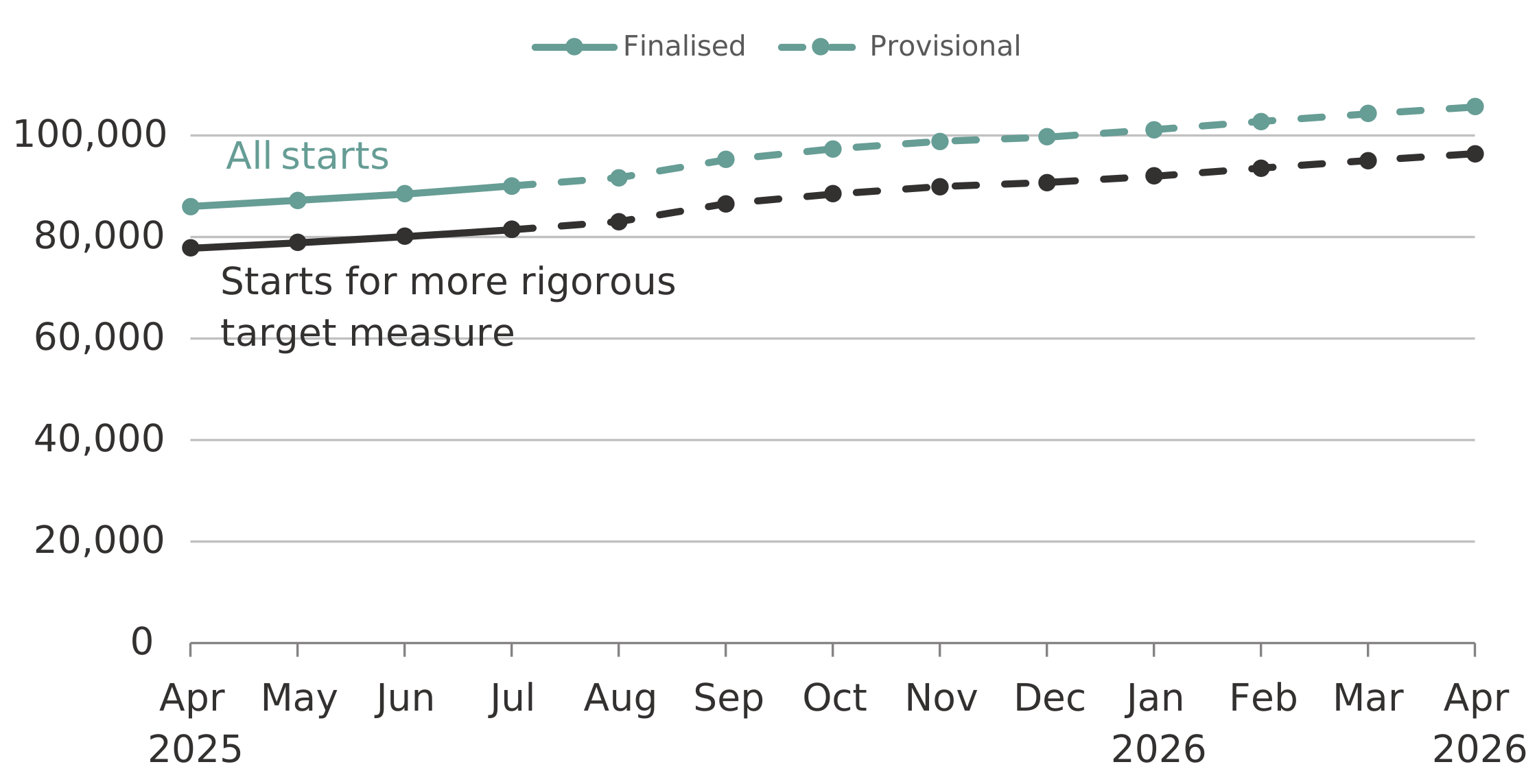
Description: There were fewer starts in December 2025 than other months. This is typical.
Providers have an 8 week period to record an apprentice as starting. This management information will not include all the apprentices who have started in the given time period.
It also takes time to learn if an apprentice is ineligible for the more rigorous target measure, which excludes apprentices who withdraw in the first 8 weeks, and those who transfer out of their programme to other learning.
Providers continuously make changes to their records to ensure accuracy. The final position for official statistics is based on the record as it stands in December after the end of the academic year.
This is the final monthly update of management information on progress towards the 100,000 apprenticeship target.
The management information is collected on the Thursday of the 3rd full week of the month. The figures reported in June should give a reasonable indication of the final figures over the 2021 to 2026 Senedd period, although we won’t have a complete picture of withdrawals, until the final data is published.
The final position on the apprenticeship target according to the quality assured official statistics, will be reported in the Apprenticeship learning programmes report scheduled to be published in Spring 2027.
Sta/Medr/10/2026: Apprenticeships learning programmes started: November 2025 to January 2026 (provisional)
Official statistics
Official statistics reference: Sta/Medr/10/2026
Date: 28 May 2026 (updated 25 June 2026)
Summary: This publication contains statistics on apprenticeship learning programmes started. Includes data by region of domicile, programme type, age group, sector, gender and academic year.
Sta/Medr/10/2026 Apprenticeships learning programmes started November 2025 to January 2026 (provisional) v2Secondary documents
Find out more about Medr’s work
You can subscribe to updates to be the first to know about our publications, news and job opportunities.
SubscribeSta/Medr/09/2026: Finances of higher education institutions, August 2024 to July 2025
Introduction
This statistical release provides a summary of financial information submitted to the Higher Education Statistics Agency’s finance record by Welsh higher education institutions.
In March 2026, Medr published Financial sustainability of the higher education sector in Wales which provides a more in-depth assessment of the finances of the higher education sector in Wales. There are some differences between the figures in each report. This report includes the University of Wales as it submits data to the HESA finance record, while the financial sustainability report excludes this institution.
Income
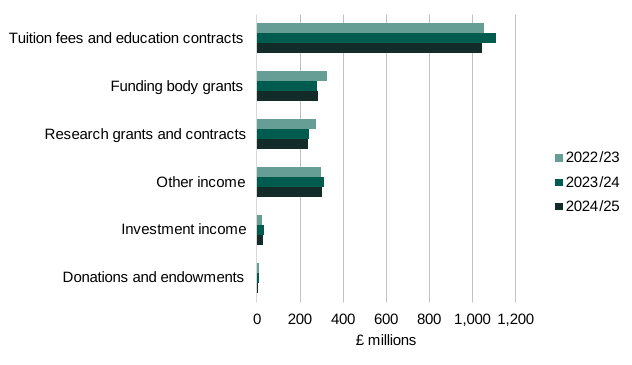
Chart 1: Breakdown of income categories at all Welsh HE institutions, 2022/23 to 2024/25
Source: HESA Finance Table 1
The total combined income of Welsh higher education institutions was £1.90 billion in 2024/25. In both 2022/23 and 2023/24, it was £1.98 billion.
Tuition fees and education contracts accounted for £1.04 billion of income in 2024/25, making it the largest source of income. This was a 6% decrease from the 2023/24 of £1.11 billion.
Funding body grants was the only income category to have risen between 2023/24 and 2024/25, increasing by 3% from £276 million to £285 million. As well as funding from Medr, funding body grants can include funding for further education institutions within higher education groups, and some other UK government funding.
Research grants and contracts accounted for £237 million worth of income in 2024/25.
The remaining income categories all saw a decrease in 2024/25.
Expenditure
Note: the calculation of underlying expenditure in this release differs from the 2023/24 release in that technical non-cash accounting adjustments to defined benefit pension schemes are excluded from interest and other finance costs, in addition to staff costs. The 2023/24 release only excluded these from staff costs. This change has been made to align with standard practice in the sector and other Medr publications.
The HESA finance record does not collect restated figures for pension cost adjustments, so the originally submitted figures have been used.
Table 1: Comparison of expenditure types for all Welsh HE institutions, 2022/23 to 2024/25 (£M)
| Expenditure type | 2022/23 (£M) | 2023/24 (£M) | 2024/25 (£M) |
|---|---|---|---|
| Total expenditure | 1,889 | 1,679 | 2,020 |
| Underlying expenditure | 1,945 | 2,056 | 2,026 |
| Underlying operating expenditure | 1,943 | 2,039 | 1,977 |
Sources: HESA Finance Table 1, Table 8 and Table 12.
(Table 1 contains the broad expenditure categories. Table 8 contains the pension adjustments to the ‘interest and other finance cost’ category in the ‘interest and other finance costs’ column, viewable when HESA cost centre group filter is ‘other expenditure’ and HESA cost filter is ‘pension cost adjustment’. Table 12 contains the changes to pension provisions and pension adjustments for ’staff costs’.)
Total expenditure, as reported in statutory accounts, includes both technical non‑cash pension adjustments and one‑off items such as fundamental restructuring costs. The pension adjustments are based on actuarial valuations of the pension schemes and can fluctuate significantly dependent on market value at the point of valuation. This can give a misleading picture of underlying costs.
Underlying expenditure removes technical non‑cash pension adjustments from staff costs and interest and other finance costs.
Underlying operating expenditure further excludes the cost of fundamental restructuring. As restructuring costs are one‑off by nature, they are not part of normal ongoing operations.
In 2024/25, underlying operating expenditure declined by 3% to £1.98 billion.
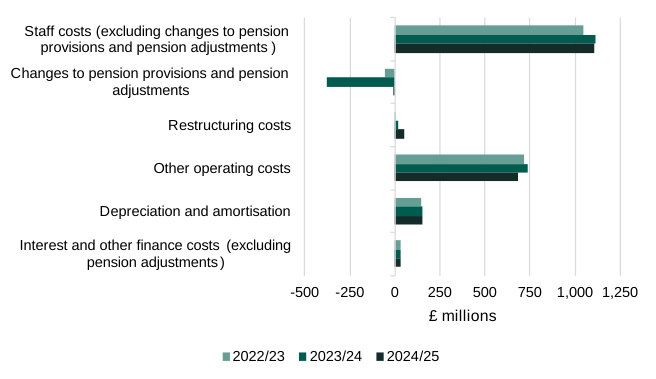
Chart 2: Breakdown of expenditure categories at Welsh HE institutions, 2022/23 to 2024/25
Sources: HESA Finance Table 1, Table 8 and Table 12.
(Table 1 contains the broad expenditure categories. Table 8 contains the pension adjustments to the ‘interest and other finance cost’ category in the ‘Interest and other finance costs’ column when HESA cost centre group filter is ‘other expenditure’ and HESA cost filter is ‘pension cost adjustment’. Table 12 contains the changes to pension provisions and pension adjustments for staff costs.)
Both staff costs (excluding technical non-cash changes to pension provisions and pension adjustments) and other operating costs declined in 2024/25. Staff costs were recorded at £1.1 billion in 2024/25; they declined by less than 1%.
Other operating costs declined by 8% to £681 million in 2024/25.
Underlying operating position
The underlying operating position is the surplus or deficit from core operational activities at universities. In this publication, it has been calculated by subtracting underlying operating expenditure (which excludes technical non-cash pension adjustments and one-off fundamental restructuring costs) from total income.
In 2024/25, Welsh universities collectively reported an operating deficit of £81 million. This deficit was £56 million in 2023/24. In 2022/23, there was an operating surplus of £40 million.
Data
Figures for 2024/25 are for the year ended 31 July 2025, with previous data years following the same pattern.
This release does not include data from the Open University in Wales, as the Open University only produces financial data on a UK wide basis. The University of Wales (central functions) has been included in this release, meaning that figures may vary slightly from Medr’s Financial sustainability of the higher education sector in Wales, March 2026 report, which did not include the University of Wales in its figures, as the University of Wales is not currently an awarding body for other institutions in Wales and has limited activity as a standalone entity. Further education or sixth form colleges and alternative providers of higher education are also excluded.
The HESA finance record permits providers to amend their figures for each year in the subsequent submission. This publication uses the most recently published figures. The 2023/24 figures will be those taken from the 2024/25 submission and may therefore differ to previous publications. The exception is non-cash pension adjustments included in ‘interest and other finance costs’, where the finance record does not collect an amended value.
The data can be found on the HESA Open Data website which also includes data for individual providers.
Sta/Medr/09/2026: Finances of higher education institutions, August 2024 to July 2025
Medr statistics
Reference: Sta/Medr/09/2026
Date: 19 May 2026
Designation: Official Statistics
Summary: Breakdown of the income and expenditure of higher education institutions in Wales for August 2024 to July 2025
Sta/Medr/09/2026 Finances of Higher Education Institutions, August 2024 to July 2025Secondary documents
Find out more about Medr’s work
You can subscribe to updates to be the first to know about our news, publications and job opportunities.
Subscribe