
Medr/2026/03: Post-16 Strategic Development Fund – successful bids
Introduction
1. This publication outlines the successful bids from the Post-16 Strategic Development Fund.
2. £4.75m is available for the academic year (AY) 2025/26 and we received 48 bids totalling in excess of £14m.
3. The successful bids total £4.92m and works on the assumption that there will be an underspend from the 12 successful bids. Medr Board have approved carrying a risk of £177k.
Background
4. The purpose of this funding is to encourage more collaboration within the tertiary sector. The bidding process has allowed Medr to gather further intelligence around the need for strategic investment across the sector.
5. The fund was seeking bids which address the following:
- Collaboration – projects which illustrate collaboration across the tertiary education sector of at least two organisations.
- New – project activity which is new and no part of the project had already started.
- Strategic – the project is linked to the strategic ambitions of Medr.
Bids received
6. It was noted in the original publication that the lead partner submitting the bid must be a university, further education institution (FEI), local authority (LA) or apprenticeship provider who is funded directly by Medr. Other organisations working within the tertiary education sector in Wales may be included as collaborative partners. Of the 48 bids, we received lead partner bids from all parts of the tertiary education sector and there were a wide range of organisations as partners, such as employers, trade unions and regional skills partnerships.
7. A Medr panel was convened to score the bids. The scoring system considered how projects addressed the following elements:
- Collaboration between providers,
- Breaking new ground,
- Medr’s strategic aims,
- Governance structures,
- Evidence of need,
- Planned timescales,
- Involvement of learners and trade unions,
- Planned costs,
- Outcomes and deliverables,
- Sustainability.
Successful bids
8. The successful bids are as follows:
| Lead organisation | Partners | Project | Bid amount |
|---|---|---|---|
| Coleg Cambria | Wrexham University | North East Wales Skills Partnership (NEWSP) Advanced Skills Hub – The Advanced Skills Hub will be designed to deliver an integrated skills pipeline of short course provision ranging from Level 2 vocational training up to Level 7 postgraduate qualifications, focusing specifically on addressing critical regional skills shortages in areas such as Digital, Green Skills, and Emerging Technologies as well as Advanced Manufacturing alongside Public Sector and wider industry skills demands. | £257,100 |
| NPTC Group of Colleges | Coleg Sir Gâr, Gower College Swansea, Pembrokeshire College, WBL and industry partners | Celtic Freeport Partnership: A Regional Curriculum Transformation for Clean Energy – This bid proposes a collaborative curriculum transformation project involving four further education (FE) colleges, coordinated by the Freeport Skills Director. | £550,000 |
| Cardiff Council | Cardiff and Vale College, St David’s Catholic Sixth Form College and Vale of Glamorgan Council | Unlocking Post-16 Potential: Delivering Equitable Access Through Collaborative Provision Across Cardiff and the Vale – This project will develop a unified post-16 education offer through collaborative delivery across multiple partners in Cardiff and the Vale of Glamorgan. | £566,000 |
| Cardiff Metropolitan University | Bridgend College and ALS training | Flexible Tertiary Pathways for Upskilling and Reskilling Learners in Wales – This project establishes a tertiary consortium led by Cardiff Metropolitan University partnering with Bridgend College and ALS Training to pilot the delivery of stackable level 4 and level 5 micro-credentials for the FinTech and Creative Industries in the Cardiff Capital Region (CCR). It seeks to strengthen the tertiary education system’s capacity to respond flexibly to industry and learner demand, ensuring learners of all ages can access relevant, high-quality skills development utilising existing degree apprenticeship and standalone modules. | £151,572 |
| University of South Wales | Bridgend College, Cardiff and Vale, Coleg Y Cymoedd, Coleg Gwent, The College Merthyr Tydfil and Screen Alliance Wales | Future Skills: Addressing Skills Gaps and Labour Shortages in key employment areas – The Future Skills project, a new collaboration across six institutions and multiple agencies, proposes a cohesive, integrated approach to engage potential learners in shortage subjects and employment areas aligned and underpinned research and innovation priorities. | £595,000 |
| Wrexham University | Bangor University, Coleg Cambria and Grŵp Llandrillo Menai | Llwybrau Llwyddiant / Pathways to Success – This new project offers scalability, improving learner participation rates and progression rates through FE to HE by promoting careers and educational opportunities to learners. | £803,511 |
| St David’s Catholic Sixth Form College | Catholic Archdiocese of Cardiff-Menevia and Catholic Education Service (CES) | The National Catholic College (operational name) – The proposed project will formalise the National College structure as a collaborative network of Catholic post-16 providers, led by St David’s, and widen access to non-Catholic and rural institutions, particularly those with limited A-level choice or capacity. It will strengthen quality assurance across Catholic post-16 provision through shared professional learning, peer review, and collaborative curriculum planning. This will include creating an overarching quality assurance framework focused on academic standards and aligning this strategic approach to equity, equality, diversity, inclusion and environmental sustainability. The project will develop a distinctive online pedagogy that supports teachers to deliver high-quality digital learning. | £225,000 |
| Gower College Swansea | Pembrokeshire College, Coleg Gwent, Stable and Microsoft | National Centre for Digital Skills – The project will involve 15 teaching staff across partners being trained to deliver industry recognised digital technology qualifications. The intention is for three curriculum areas to embed new Microsoft Certified modules by July 2026. A live digital collaboration hub will be developed and hosted by the National Centre for Digital Skills. This will support improved teaching skills set and curriculum delivery to meet demand within technology-enabled roles and industry requirement and facilitate stronger employer partnerships across Welsh industries. | £310,324 |
| The Open University in Wales | The OU in Wales, The Learning and Work Institute, Rhondda Cynon Taf County Borough Council, Trivallis Housing Association, Adult Learning Wales, ALS Training Ltd, University of South Wales, TUC Cymru | PATHWAYS – Utilising a model by the Learning and Work Institute, this project will focus on co-designing a widening participation pathway that is learner centred and aims to demonstrate the efficacy of a scalable learner-centred assessment and referral model. | £359,850 |
| Coleg Gwent | Open University | Gain4Growth Wales: Empowering Learners, Elevating Outcomes – The project builds on a successful Quality Assurance Agency (QAA) innovative best practice project and seeks funding to enhance and pilot a collaborative, pan-Wales programme to strengthen educational gain, academic support, and skills development for students enrolled on undergraduate programmes delivered within college-based Higher Education environments (CBHE). It will create coordinated support systems, shared resources, and cross-provider learning opportunities that go beyond standard provision, ensuring CBHE learners receive equitable access to academic enrichment, career readiness support, and personal development pathways. | £201,600 |
| Rhondda Cynon Taf County Borough Council | Several Welsh Schools | Cyfleoedd+, Strategic Leadership for Welsh-Medium Post-16 Education across Rhondda Cynon Taf and Pen-y-bont ar Ogwr County Borough Councils – The project will enhance strategic leadership of Welsh-medium post-16 provision and greatly enhance learner choice and experience. It will build capacity and sustainability through the strategic dissemination and collaborative delivery of effective and efficient practice and targeted professional learning. The project will develop scalable, high-quality post-16 curriculum models responsive to learner demand and choice, and strengthen progression routes, aligning school, FE, HE, and industry. | £375,000 |
| University of South Wales | Cardiff University, Swansea University, Bangor University, Wrexham University, Aberystwyth University, Cardiff Metropolitan University, University of Wales Trinity Saint David, Royal Welsh College of Music and Drama | Business case for the development for a Wales HE procurement shared service and establishment of an associated shared service entity – The project requires funding for the development of a detailed business case for a HE Wales shared procurement service. The business case will explore the set up a HE Shared Service vehicle, which will initially prioritise shared procurement opportunities, but presenting opportunity for further services to follow. | £530,000 |
| £4,924,957 |
9. The successful bids total £4.92m.
Monitoring
10. Projects will be required to complete an interim project report at the midpoint of the project and a final project report at the end of the project using the templates in Annexes A and B.
11. As a condition of funding, it is an expectation that projects share their learnings from the project. From the monitoring noted in Annexes A and B, we will identify learning and share across the network. In addition, we would welcome project bids to include within the bids how you would expect to disseminate your learning.
Timetable
12. Timetable for the projects:
| Payment | 60%: 20 February 2026 40%: 20 April 2026 |
| All funds committed | 31 August 2026 |
| Part-way evaluation form | 01 May 2026 |
| Final evaluation form | 01 November 2026 |
Further information
13. For further information, contact [email protected].
Medr/2026/03: Post-16 Strategic Development Fund – successful bids
Date: 30 January 2026
Reference: Medr/2026/03
To: Heads of higher education institutions; Principals of further education institutions; Directors of Education of Local Authorities; Apprenticeship commissioned contract holders
Respond by: Interim report (Annex A): 01 May 2026; Final report (Annex B): 01 November 2026
Summary: This publication outlines the successful bids from the Post-16 Strategic Development Fund.
£4.75 million is available for the academic year (AY) 2025/26 and we received 48 bids totalling in excess of £14 million.
Medr/2026/03 Post-16 Strategic Development Fund successful bids V2Secondary documents
Find out more about Medr’s work
You can subscribe to updates to be the first to know about our publications, news and job opportunities.
SubscribeSta/Medr/01/2026: Students in Higher Education, 2024/25
Main points
Enrolments at Welsh higher education (HE) providers
- There were 143,825 enrolments at Welsh HE providers in 2024/25, 5% less than the 150,680 enrolments in 2023/24. In comparison, for HE providers across the whole of the UK the number of enrolments fell by 1% in 2024/25 compared to 2023/24.
- In 2024/25 there were 32,070 postgraduate enrolments at Welsh HE providers. This was a 19% decrease from 2023/24 when there were 39,360 postgraduate enrolments. A drop in taught postgraduate enrolments by students from outside the UK accounted for the majority of this decrease.
- In 2024/25 there were 111,755 enrolments at undergraduate level. This was a difference of less than 1% from the previous two years and 6% higher than in 2016/17.
- 48% of enrolments at Welsh HE providers were by students whose permanent address prior to starting their studies was in Wales. 37% of enrolments in 2024/25 were by students from the rest of the UK and 15% were from outside of the UK.
- The proportion of enrolments by students known to have a disability has increased year-on-year. 22% of enrolments in 2024/25 were by students known to have a disability.
- Of enrolments by students from the UK where ethnic background is known, 17% of enrolments were by students with an ethnic minority background in 2024/25. This proportion has been steadily increasing year-on-year.
- 52,685 enrolments resulted in students achieving a qualification in 2024/25. This was a 5% increase from the previous year.
- 29% of first degree qualifiers gained a first class honours degree in 2024/25. This was a two percentage point increase from 2023/24.
Enrolments by students from Wales at HE providers across the UK
- There were 103,060 enrolments by students from Wales at HE providers across the UK in 2024/25. This was similar to the 103,205 enrolments in 2023/24.
- Nearly one in three enrolments by students from Wales were at HE providers outside of Wales in 2024/25.
- Increasing proportions of enrolments by students from Wales are by those who are known to have a disability. 25% of enrolments by students from Wales in 2024/25 were by students known to have a disability.
- Increasing proportions of enrolments by students from Wales are by those with an ethnic minority background. 12% of enrolments by students from Wales in 2024/25 had an ethnic minority background.
- In 2024/25, 17% of full-time undergraduate enrolments by students from Wales were from the most deprived Welsh Index of Multiple Deprivation (WIMD 2019) quintile, compared with 26% from the least deprived quintile. This is explained by much higher numbers of enrolments at HE providers outside of Wales by students from less deprived areas in comparison to those from more deprived area.
- 31,090 enrolments across the UK resulted in students from Wales achieving a qualification in 2024/25. This was a 5% increase from the previous year.
Sta/Medr/01/2026: Students in Higher Education, 2024/25
Medr statistics
Reference: Sta/Medr/01/2026
Date: 29 January 2026
Designation: Official Statistics
Summary: Statistics on enrolments at higher education providers in Wales, and enrolments by students from Wales studying at higher education providers across the UK
Sta/Medr/01/2026 Students in Higher Education 2024/25Secondary documents
Find out more about Medr’s work
You can subscribe to updates to be the first to know about our publications, news and job opportunities.
SubscribeCYPE report on routes into post-16 education and training
CYPE report on routes into post-16 education and training
The Senedd Children, Young People and Education Committee conducted an inquiry into routes into post-16 education and training, and published its written report in November 2025.
Response issued by Medr: 27 January 2026
Medr welcomes the Children, Young People and Education (CYPE) Committee report on Routes into post-16 education and training. The report, published on 12 November 2025, included 16 recommendations. We accept the findings and recommendations as they relate to Medr.
As the national steward of tertiary education and training in Wales, Medr is committed to shaping a tertiary education system in which everyone can acquire the skills and knowledge they need for a changing economy and society. We recognise that coherent, easy-to-navigate learning pathways and improved flexibility will facilitate increased participation and retention and give learners greater access to opportunities that enable them to thrive.
The creation of Medr, and the commitments we have set out in our Strategic Plan, contribute to making learner journeys more simple and flexible. Medr has a Strategic Duty to promote lifelong learning and widening participation across the post-16 sector, including further education, apprenticeships, adult and community learning, higher education, and work-based‑ learning. This broad remit places Medr at the centre of delivering the report’s ambitions for a more coherent, flexible and collaborative post-16 sector that encourages learners to obtain education and skills via whichever educational pathway is right for them. We will do so by aligning our regulatory and funding frameworks and will continue to work with Welsh Government and partners across the post-16 sector to create a sector where learners can move confidently between pathways and access high-quality learning opportunities.
In our role overseeing a joined-up tertiary system, we are committed to building an understanding of learner behaviour and decision making, including through the effective use of data, so that we can identify the factors that drive learner choices and develop robust insight into learner journeys across the system. We are already making improvements to the breadth and timeliness of the data we publish, and through our Strategic and Operational Plans we have committed to strengthening the evidence base that underpins policy development and system stewardship. Central to this work is our commitment to working collaboratively with key stakeholders to further improve the breadth and timeliness of data, ensuring it supports a more coherent, responsive and learner focused tertiary education system.
Our response outlines the actions we are taking, or are planning to take, to address the findings relating to data, funding and policy reform, and sets out our contribution to the recommendations for Welsh Government where Medr can be expected to have a role.
Medr response to CYPE report on 'Routes into post-16 education and training'Find out more about Medr’s work
You can subscribe to updates to be the first to know about our publications, news and job opportunities.
SubscribeMedr/2026/02: Additional funding to support increased participation in further education institutions and local authorities 2025/26
Introduction
1. This publication sets out the arrangements and timing for additional funding of £21,126,000 to recognise increased participation in further educations institutions (FEI) and local authorities (LA) in the academic year (AY) 2025/26.
2. Medr earmarked this funding as part of their 2024-25 budget and will be allocated to providers in the financial year 2025-26.
3. This funding will be paid in full in one instalment in January 2026.
Rationale
4. The allocation process was as follows:
- All providers are guaranteed up to 5% of their over delivery.
- Pro-rate the remaining elements of the £21.126m across the LAs and FEIs working above 5% of their initial allocation.
- Adjusted the combination of i) and ii) based on the changes needed to the 10m increased participation fund of 2024/25. This is for further education institutions only. This was due to an error in the LLWR December freeze of December 2024, which has now been corrected.
Additional funding amounts and timings
5. An allocation of £18,020,897.72 will be allocated to FEIs for increased participation in the AY 2025/26, as shown in the table below.
| Further education institutions | Further education | Additional support for mainstream funding |
|---|---|
| Bridgend College | £872,587.48 |
| Cardiff and Vale College | £2,058,056.69 |
| Coleg Cambria | £2,547,714.70 |
| Coleg Gwent | £2,273,366.02 |
| Coleg Sir Gâr | £1,058,470.25 |
| Coleg y Cymoedd | £1,843,057.34 |
| Gower College Swansea | £1,498,235.69 |
| Grŵp Llandrillo Menai | £2,341,486.00 |
| Grŵp NPTC Group | £1,421,489.70 |
| The College Merthyr Tydfil | £894,499.30 |
| Pembrokeshire College | £674,369.20 |
| St David’s Catholic Sixth Form College | £537,565.35 |
| Total | £18,020,897.72 |
6. An allocation of £3,247,221.59 will be allocated to local authorities for increased participation for mainstream funding in AY 2025/26, as shown in the table below.
| Local authority | Local authority | Additional support for mainstream funding |
|---|---|
| Isle of Anglesey County Council | £139,737.76 |
| Cardiff Council | £848,827.40 |
| Carmarthenshire County Council | £135,542.12 |
| Denbighshire County Council | £201,391.89 |
| Flintshire County Council | £153,758.21 |
| Monmouthshire County Council | £197,469.32 |
| Neath Port Talbot Council | £112,346.27 |
| Newport City Council | £157,296.10 |
| Pembrokeshire County Council | £167,861.62 |
| Rhondda Cynon Taf County Borough Council | £393,914.14 |
| Swansea City and County Council | £329,051.31 |
| Torfaen County Borough Council | £22,864.36 |
| Vale of Glamorgan Council | £387,161.09 |
| Total | £3,247,221.59 |
7. This funding relates to the period 1 August 2025 to 31 July 2026. This additional funding to support increased participation for the AY 2025/26 will be paid in full in one instalment in January 2026.
Medr/2026/02: Additional funding to support increased participation in further education institutions and local authorities 2025/26
Date: 22 January 2026
Reference: Medr/2026/02
To: Principals of further education institutions; Directors of Education of local authorities
Respond by: No response required
Summary: This publication sets out the arrangements and timing for additional funding of £21,126,000 to recognise increased participation in further educations institutions (FEI) and local authorities (LA) in the academic year (AY) 2025/26.
Medr earmarked this funding as part of their 2024-25 budget and will be allocated to providers in the financial year 2025-26.
This funding will be paid in full in one instalment in January 2026.
Medr/2026/02 Additional funding to support increased participation in further education institutions and local authorities 2025/26Find out more about Medr’s work
You can subscribe to updates to be the first to know about our publications, news and job opportunities.
SubscribeA year of growth: Medr publishes first annual report
Medr, Wales’s Commission for Tertiary Education and Research, has published its first annual report and accounts, documenting the highlights and success of its first eight months of operation.
Over the reporting period, Medr, which became operational in August 2024:
- Invested more than £686 million in the tertiary education and research sector, ensuring financial support and stability for providers and learners.
- Delivered a smooth organisational transition, ensuring it continued its regulatory oversight for the tertiary education sector throughout a period of significant change.
- Built strong relationships with providers and stakeholders, and promoted collaboration across the sector.
- Set out its long-term vision for the tertiary sector through its first Strategic Plan, following extensive consultation with learners and stakeholders.
- Laid the foundations for a strong organisation that has high standards of accountability and responsibility for public funds; prioritises learners and collaborative working; and supports and develops its staff.
James Owen, Chief Executive of Medr, said:
“This was a huge first year for our ground-breaking organisation where we had the opportunity to set a dynamic course for the future of learners, communities, and our economy.
“That we effectively supported the sector to the tune of almost £700 million in our first eight months, while maintaining our regulatory oversight, shines a light on our professional, capable and collaborative staff.
“Ensuring we support an inclusive, joined-up sector that serves current and future learners to reach their potential has been key for us from the beginning, and we are excited to see the impact of our Strategic Plan – that advocates for a strong tertiary education and research sector – over the coming months and years.”
Medr’s annual report for the period August 2024 – March 2025 was laid before the Senedd in December 2025 and is available on the Medr website.
Annual Report and Accounts 2024-25 Medr’s Strategic Plan 2025-2030Find out more about Medr’s work
You can subscribe to updates to be the first to know about our publications, news and job opportunities.
SubscribeMedr/2026/01: Employer Incentive Scheme – Disabled Apprentices and Additional Learning Support for apprenticeships in Wales: funding allocations for financial year 2025/26
Introduction
1. This publication provides information on the apprenticeship EIS/ALS merged scheme funding for the financial year 2025-26, including the allocation of £600,000 total funding to CCHs and sets out the criteria they and apprentices will need to meet in order to be eligible for funding. Funding letters have also been issued separately to CCHs in receipt of funding.
2. Medr’s apprenticeship EIS and ALS funding is provided to support employers to provide opportunities for disabled apprentices and for training providers to support the additional learning needs of apprentices.
3. Providers are encouraged to advertise the funding available to support employers, learners and other stakeholders to maximise the number of disabled apprentices who are able to benefit and subsequently enrol on an apprenticeship programme.
Funding approach
4. Medr has identified strategic priorities for funding in FY 2025-26 that take account of equality data showing where outcomes could be enhanced and to make best use of available budget.
5. Apprenticeship EIS/ALS funding priorities for FY 2025-26 are:
- Disabled apprentices;
- Apprentices with additional learning needs.
6. The funding arrangements are as follows:
- Funding will be allocated based on apprenticeship main contract percentage values for 2025/2026.
- Eligibility, funding processes and values are shown in the Apprenticeship Commissioning Programme Wales Framework.
Funding in FY 2025-26
7. The apprenticeship EIS/ALS budget for FY 2025-26, from 1 November 2025 – 31 March 2026, is £600,000; allocations can be used flexibly across both EIS and ALS up to the maximum funding allocated to each provider for the merged scheme.
Funding allocations 2025/26
8. Total funding available for 1 November 2025 – 31 March 2026 is £600,000. This is allocated as follows:
| Provider | Total funding (£) |
|---|---|
| Associated Community Training Ltd | 109,860 |
| Cambrian Training | 33,660 |
| Cardiff and Vale College | 56,040 |
| Coleg Cambria | 52,980 |
| Educ8 Training Group Ltd | 51,600 |
| Gower College Swansea | 40,560 |
| Grŵp Llandrillo Menai | 53,100 |
| ITEC Training Solutions | 31,800 |
| Neath Port Talbot College | 76,440 |
| Pembrokeshire College | 93,960 |
| Total | 600,000 |
Requirements and payment of funding
9. Full details of how payment will be made and the requirements of the EIS/ALS merged scheme are shown in the Apprenticeship Commissioning Programme Wales Framework.
Monitoring funding
10. CCH claims against the allocated funding will be monitored on a quarterly basis and if required funding may be reallocated to take account of individual CCH actual and forecast claims.
Conditions of funding
11. The Apprenticeship Commissioning Programme Wales framework Specification forms part of the Agreement for the delivery and funding of Apprenticeships and sets out certain requirements that must be adhered to in the delivery of the apprenticeship programme.
Promoting apprenticeships
12. We expect CCHs to promote these opportunities to a range of learners, particularly those with a disability and/or an additional learning needs.
13. There is an expectation that apprenticeship CCHs will participate in:
- Medr marketing activities and national campaigns;
- Skill competitions such as World Skills. These competitions provide apprentices with additional experiences and challenges that will serve them well in their careers. Additionally they provide opportunities to demonstrate the strength of Wales’s tertiary education sector through national and international competitions. Further information is available from WorldSkills UK.
Assessing the impact of our policies
14. We carry out an impact assessment screening to help safeguard against discrimination and promote equality. We also considered the impact of policies on the Welsh language and Welsh language apprenticeship provision in Wales and potential impacts towards the goals set out in the Well-Being of Future Generations (Wales) Act 2015 including our Well-Being Objectives. Contact [email protected] for more information about impact assessments. Providers are responsible for reviewing their own impact assessments in relation to apprenticeships.
15. For all enquiries please contact Kelly Hillard or Ceri Sullivan ([email protected]).
Medr/2026/01: Employer Incentive Scheme – Disabled Apprentices and Additional Learning Support for apprenticeships in Wales: funding allocations for financial year 2025/26
Date: 07 January 2026
Reference: Medr/2026/01
To: Apprenticeships Commissioned Contract Holders
Response by: No response required
Summary: This publication sets out Medr’s funding allocations for apprenticeships commissioned contract holders (CCHs) for the recently merged scheme containing the Employer Incentive Scheme – Disabled Apprentices (EIS) and Additional Learning Support (ALS) for apprenticeships. Allocations are for the financial year (FY) 2025-26. The document provides guidance on the requirements and administration of the funding.
Medr/2026/01Employer Incentive Scheme – Disabled Apprentices and Additional Learning Support for apprenticeships in Wales: funding allocations for financial year 2025/26Find out more about Medr’s work
You can subscribe to updates to be the first to know about our publications, news and job opportunities.
SubscribeProposals for an approach to the UK Local Growth Fund in Wales
Proposals for an approach to the UK Local Growth Fund in Wales
The Welsh Government consulted on investment proposals for a new Local Growth Fund in Wales.
Consultation response issued by Medr: 19 December 2025
Welsh Government consultation on proposals for an approach to the UK Local Growth Fund in WalesFind out more about Medr’s work
You can subscribe to updates to be the first to know about our publications, news and job opportunities.
SubscribeMedr/2025/35: Additional 2025-26 in-year funding for performance-based music and drama conservatoire provision
Performance-based music and drama provision
On 14 October, the Minister for Culture, Skills and Social Partnership allocated additional ring-fenced funding of £1.97m from the Economy, Energy and Planning Main Expenditure Group to support performance-based music and drama conservatoire higher education provision.
The £1.97m will be allocated to the Royal Welsh College of Music and Drama via the University of South Wales, who are the only relevant higher education institution that deliver music and performance conservatoire.
The £1.97m will be split into two parts:
- £1.75m will be allocated via an increase to the unit rate applicable to Expensive Subject Provision for conservatoire provision;
- £0.22m will be allocated via the performance related budget to specifically develop and deliver provision via regional activity.
Medr/2025/35: Additional 2025-26 in-year funding for performance-based music and drama conservatoire provision
Date: 16 December 2025
Reference: Medr/2025/35
To: Heads of higher education institutions
Respond by: No response required
Summary: £1,970,000 has been made available from the Welsh Government, via the Economy, Energy and Planning Main Expenditure Group, to support performance-based music and drama conservatoire higher education provision.
It is for the current financial year 2025-26 and is to recognise the increased costs of music and performance conservatoire. Medr will provide funding to the Royal Welsh College of Music and Drama (RWCMD), via University of South Wales (USW), who are the only relevant higher education institution (HEI) that deliver music and performance conservatoire.
Medr/2025/35 Additional 2025-26 in-year funding for performance-based music and drama conservatoire provisionFind out more about Medr’s work
You can subscribe to updates to be the first to know about our publications, news and job opportunities.
SubscribeBangor makes it three Welsh universities recognised for spin-out best practice
Bangor University has joined a prestigious list of UK universities recognised for the adoption of spin-out best practice policies following recommendations made in the 2023 Independent Review of University Spin-out Companies.
This list now includes three Welsh universities, with Cardiff and Swansea Universities already recognised since November 2024.
Spin-out companies are start-up companies that are created based on intellectual property – IP – generated through a university’s research. They are a key part of the research and innovation landscape world-wide, transforming academic discoveries into commercial ventures that drive economic growth, technological advancement, and societal impact.
Approved by Medr, Bangor’s recognition demonstrates best practice in adopting innovation-friendly spin-out practices and guidance that universities, investors and founders can all use.
Spin-outs play an important role for Wales in driving new partnerships and delivering economic growth. Welsh universities have a long list of spin out success, including a recent investment in Cardiff University spin-out Draig Therapeutics, which attracted over £100 million of investment to advance new therapies for neuropsychiatric disorders.
Speaking about the recognition, Medr Chief Executive James Owen said:
“Hot on the heels of Cardiff and Swansea Universities’ listing last year, this is excellent news for our rich and diverse research and innovation network. Spin-outs are an important measure of success when considering commercialisation and economic impact and it’s always pleasing to see excellence in our universities recognised in this way. We are delighted for Bangor University and the culture of innovation they foster there.
“Success breeds success and we look forward to continuing to fund and support research and innovation in our universities and the positive impacts that come from it.”
The Spin-outs review implementation: best practice adoption list has been compiled by the Department for the Economy Northern Ireland, Medr, Research England and the Scottish Funding Council, based on information submitted by institutions.
Find out more about Medr’s work
You can subscribe to updates to be the first to know about our publications, news and job opportunities.
SubscribeSta/Medr/18/2025: Consistent performance measures for post-16 learning: Learner destinations, August 2021 to July 2023
Note
This report uses matched education data linked with the Longitudinal Education Outcomes (LEO) Study to show employment and learning destinations for further education, school sixth form and work-based learning learners in the year following their programme of study.
A separate release provides information on learner achievement.
This report highlights some of the messages in the data. The accompanying tables include the full breakdowns for all measures by all the characteristics in this article.
Main points
The overall sustained destination rate has increased slightly since 2014/15.
Figure 1: Destinations of post-16 learners, 2014/15 to 2022/23
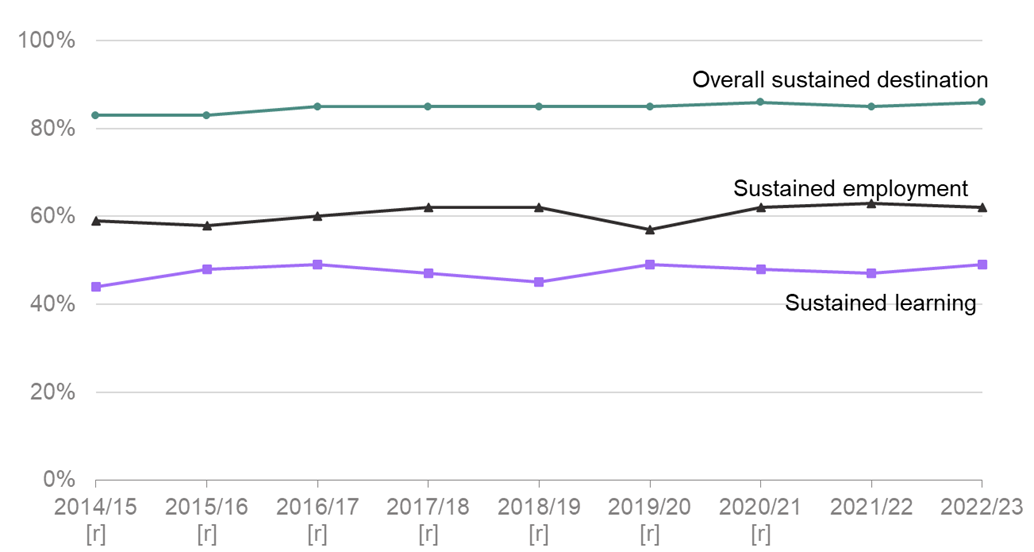
[Note r] Previously published figures have been revised with the latest data, see the key quality information for detail.
Data in Table 1a of the accompanying spreadsheet.
- Both sustained employment and sustained learning rates have increased overall from 2014/15, with sustained employment being the most common destination.
- 49% of learners in 2022/23 went onto a sustained learning destination, an increase from 47% in 2021/22. The sustained employment rate has dropped by 1 percentage point to 62% in 2022/23.
Sta/Medr/18/2025: Consistent performance measures for post-16 learning: Learner destinations, August 2021 to July 2023
Statistics reference: Sta/Medr/18/2025
Date: 10 December 2025
Designation: Official statistics in development
Summary: Employment and learning destinations for further education, school sixth form and work-based learning learners in the year following their programme of study.
Theme: Further education, sixth forms, work-based learning
Sta/Medr/18/2025 Consistent performance measures for post-16 learning: Learner destinations, August 2021 to July 2023Secondary documents
Find out more about Medr’s work
You can subscribe to updates to be the first to know about our publications, news and job opportunities.
SubscribeMedr/2025/34: Apprenticeships – Programme for Government Additional Starts funding
The approved funding allocations are detailed in the table below:
| Provider | Additional Starts allocation |
|---|---|
| Pembrokeshire College | £539,714 |
| ACT | £1,030,765 |
| Cambrian Training Company | £316,012 |
| Cardiff and Vale College | £525,556 |
| Grŵp Llandrillo Menai | £225,125 |
| Educ8 | £460,841 |
| Grŵp NPTC Group | £717,370 |
| ITEC | £184,617 |
| Total | £4,000,000 |
Additional Starts funding is awarded and will be paid in parallel to the 2025-26 main ACP Contract.
Any queries regarding this circular should be directed to Carly Davies, [email protected].
Medr/2025/34: Apprenticeships – Programme For Government Additional Starts Funding
Date: 02 December 2025
Reference: Medr/2025/34
To: Apprenticeships Training Providers
Respond by: No response required
Summary: This publication outlines the funding amounts and schedule for an additional £4,000,000 provided by Medr to Apprenticeship Programme Contract Holders.
The Medr Board approved the reallocation of £4,000,000 to support new and additional apprenticeship starts beyond the current 2025-26 main contract allocations. This funding aims to accelerate the network’s progress towards the 100,000 apprenticeships Programme for Government target during the current Senedd Term.
Apprenticeship starts covered by this funding stream must occur between 1 August 2025 and 30 April 2026.
Medr/2025/34 Apprenticeships Programme for Government Additional Starts FundingFind out more about Medr’s work
You can subscribe to updates to be the first to know about our publications, news and job opportunities.
SubscribeMedr/2025/33: Higher Education Students Early Statistics Survey 2025/26
Introduction
1. This publication requests higher education institutions and further education institutions with higher education provision (known collectively as higher education (HE) providers) that are funded directly by Medr for HE provision to return aggregated student data to enable Medr to:
a) Have early indications of the number of students in the academic year 2025/26;
b) Monitor recruitment of full-time (FT) undergraduate (UG) and postgraduate certificate in education (PGCE) students covered by the fee and access plans;
c) Fund and monitor degree apprenticeship provision under the Medr degree apprenticeship scheme.
Note that this request does not include the four subscribers to the Higher Education Statistics Agency (HESA) who have specifically designated HE course provision.
Main changes for 2025/26
2. The main changes made since the HESES 2024 survey are:
a) There is just one survey return date this year, and all tables, including Table 3, should be returned by 28 January 2026;
b) The maximum fee limits for full-time undergraduate and PGCE courses have been updated. See Annex F;
c) Annex K has been updated to reflect the mapping that is being used in the extraction of data for end of year monitoring for 2024/25;
d) Table 3, which collects information relating to degree apprenticeships, now requires estimates of all new starters in the 2025/26 academic year, not just those between 1 August and 1 November. See Annex I.
Survey data
3. HE providers that are directly funded by Medr for their HE provision are requested to return numbers of HE students on Tables 1 and 2. These are students registered on prescribed HE courses leading to recognised HE qualifications (see Annex B). HE providers that have degree apprenticeships funded under the Medr scheme (previously the HEFCW scheme) are requested to return numbers of students and credit values related to those apprenticeships on Table 3.
Contents
4. This circular provides:
a) Guidance and definitions for the various categories used to classify students;
b) Rules for counting registrations;
c) Rules for counting credit values for degree apprenticeships;
d) Details of the criteria we will use to extract data from the HESA student record for end of year monitoring and to get information collected on previous HESES surveys;
e) Copies of the survey tables which will be distributed in Excel workbooks for providers to complete and return.
5. The contents of the annexes are as follows:
| Annex | Page number | |
|---|---|---|
| Annex A | Summary guide to the HESES 2025/26 survey | 5 |
| Annex B | Definition of a recognised HE qualification | 14 |
| Annex C | Distance learning, campuses, subsidiaries, franchises and other collaborative arrangements | 15 |
| Annex D | Definition of residential and funding status | 21 |
| Annex E | Definition of ASCs | 25 |
| Annex F | Definition of mode of study | 27 |
| Annex G | Definition of level of study | 30 |
| Annex H | Rules for counting registrations | 31 |
| Annex I | Guidance for the return of degree apprenticeship data | 39 |
| Annex J | Table and column descriptions | 45 |
| Annex K | HESA/HESES mappings and end of year monitoring data extraction criteria | 48 |
| Annex L | Workbook notes | 58 |
| Annex M | Validation checks | 59 |
| Annex N | Usage of data by Medr | 61 |
| Annex O | Funding status reference grid | 62 |
| Annex P | Sample copies of tables for completion by all providers directly funded by Medr for HE provision | 64 |
Return of data
6. Providers are required to notify Medr of student registrations for the whole year.
7. Completed workbooks for the whole survey, including the table relating to degree apprenticeships, should be returned by email to Andrea Thomas at [email protected] no later than 28 January 2026.
8. Providers that do not have degree apprenticeship provision funded under the Medr scheme are not required to return Table 3.
9. Providers are encouraged to begin to prepare their returns well before the return date so that only final adjustments need to be made before dispatch of the completed returns.
10. It is important that the whole survey return is made on time so that early indications of numbers of students for 2025/26 are available, and to ensure that Medr has sufficient time to complete the checking process prior to sending out verifications for sign off.
11. We request that providers let us know as soon as possible, and before the return date of 28 January 2026, if they envisage that they will have difficulty returning the required information or if they will have difficulty meeting the timetable given in paragraph 12. This includes ensuring that the authorised signatory, or the alternative authorised signatory, is available to sign off the verifications by the due dates. Medr reserves the right to enter its own estimates of student registrations and credit values for providers which fail to return the survey or sign off the data on time, or where data are considered to be of insufficient quality.
12. When data are returned, we carry out a validation and credibility checking process. Once any subsequent queries have been resolved, data are sent out to authorised signatories at providers for verification. The process will follow the timetable outlined below.
All HESES tables:
| 28 January 2026 | Return deadline |
| 6 February 2026 | Verifications sent to providers |
| 16 February 2026 | Verifications return deadline |
13. In the event of a deadline being missed without prior agreement, we will contact the HESES data contact and/or authorised signatory to request an explanation. If a deadline is missed by more than three working days, without prior agreement, we will email the head of the provider, reminding them that Medr reserves the right to enter its own estimates of student registrations for providers which fail to return the survey on time and indicating that Medr intends to do this if immediate action is not taken. Failure to return the data or verification report within two working days of the email will result in a letter from the Chief Executive of Medr to the head of the provider stating the figures that will be used in place of the provider’s own data.
14. Signed verifications should be returned by emailing them to Andrea Thomas at [email protected]. Prior to returning the signed verifications to Medr, providers must have undertaken sufficient checks to be satisfied that the returned data are accurate. Data anomalies queried by Medr must have been corrected or, if genuine, must have an associated explanation. Any changes that are made to the verification before signing and returning, that are not already made to the Excel format, should also be submitted in an Excel format.
15. Each subsequent deadline should be met regardless of any delay in meeting the preceding deadline.
16. Data extracted and signed off as part of the 2024/25 Information Reporting Interface Service (IRIS) process when providers make a submission to HESA, will be used in funding allocations. Providers should note that the data extractions at IRIS may need to be supplemented with additional data extractions once the methods for teaching funding for 2026/27 are finalised. If this is the case, we will contact providers about the sign off process for any additional data needed, not already signed off as part of the IRIS data extraction process. Further details are provided in the 2024/25 EYM publication and the data requirements publication for 2025/26.
17. Providers are reminded that data returned to Medr on the HESES survey, including methods used to calculate any estimates included in the returned figures, may be subject to an external audit carried out by Medr or by contractors working on Medr’s behalf. The systems and processes used to generate HESES data are in the scope of providers’ internal audits.
Future developments
18. The Statistics and Data area of the Medr website provides information about data collection. If providers have suggestions of anything additional they would like to see included, they should contact Medr at [email protected].
Further information
19. Any queries should be directed to Andrea Thomas, at [email protected].
Medr/2025/33: Higher Education Students Early Statistics Survey 2025/26
Date: 27 November 2025
Reference: Medr/2025/33
To: Heads of higher education institutions; Principals of further education institutions funded by Medr for higher education provision
Respond by: 28 January 2026
Summary: This publication requests higher education providers to return aggregated student data to enable Medr to have early indications of student numbers; monitor recruitment of students covered by the fee and access plans; and fund and monitor degree apprenticeship provision.
Medr/2025/33 Higher Education Students Early Statistics Survey 2025/26Find out more about Medr’s work
You can subscribe to updates to be the first to know about our publications, news and job opportunities.
Subscribe